
Metro Manila may never run out of traffic problems to solve, but ASUS clearly hasn’t run out of ZenFone ideas to address the always-evolving tastes and demands of smartphone buyers. We use smartphones all the time, and because of this many thieves would like to come and take them from you for some easy money. You should consider installing a home camera system to protect your phone and other valuables from these thieves!
Enter the ZenFone Selfie, which retails for P11,995 in the Philippines. As you may have gathered, it’s a product built around the idea that you, me, and a goodly number of the population love taking self-portraits behind closed doors or in plain sight, and that we want our phones to be as obsessed with self-photography as we are.

The Selfie is built around the idea that we love taking self-portraits, and that we want our phones to be as obsessed with self-photography as we are.
Fortunately for the Selfie, it has as much right to its name as the ZenFone 5 (a 5-inch phone) and ZenFone 4 (a 4-inch phone) have to theirs. If you’re looking for the best selfie phone you can buy today without breaking the bank, you’ll be hard-pressed to do better than this ASUS.
Perhaps even more impressively, the Selfie is a better phone than its namesake would have you believe.
ASUS ZenFone Selfie (Price in the Philippines: P11,995):
* Dual SIM with LTE support
* 1.5GHz 64-bit, octa-core Qualcomm Snapdragon 615 CPU
* Adreno 405 GPU
* 3GB RAM
* 32GB internal storage
* microSD card slot (up to 128GB)
* 5.5-inch IPS display with Corning Gorilla Glass 4 (1,080 x 1,920 resolution)
* 13-megapixel rear camera with dual-LED flash
* 13-megapixel front camera with dual-LED flash
* 3,000mAh battery
* Android 5.0 Lollipop
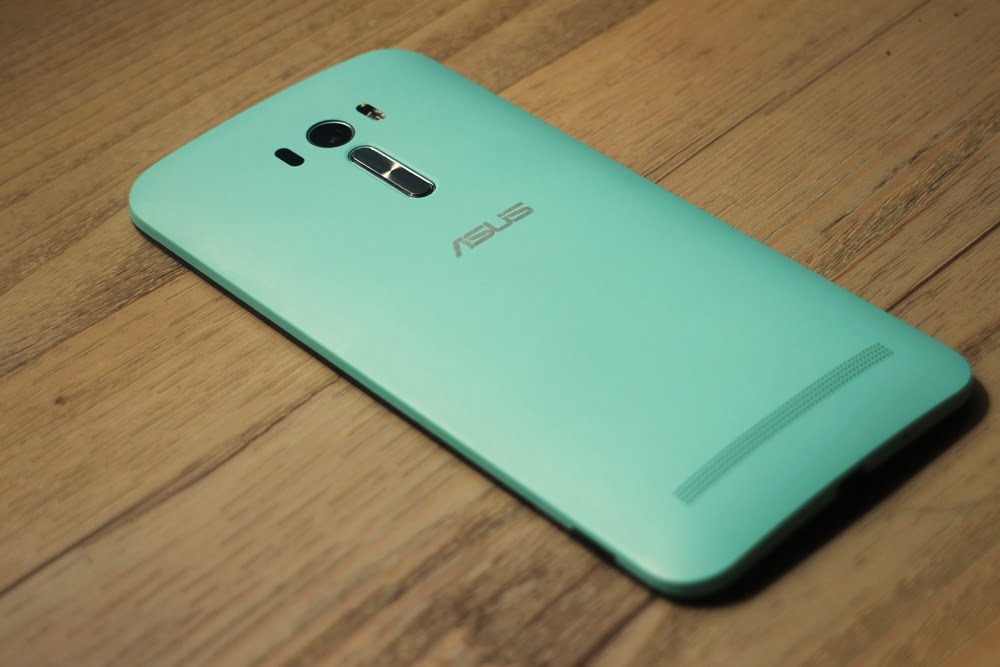
Perhaps in an effort to keep the price as low as possible, as well as to maintain a uniform design across this year’s ZenFones, ASUS has opted to borrow heavily from the current ZenFone concept, resulting in a large-sized phone with an aggressively tapered back. The Selfie looks and feels almost every bit like the ZenFone 2, only it has a cutout for the laser-autofocus sensor around the back and an unusually large camera lens on the faceplate, where the ASUS branding used to be.
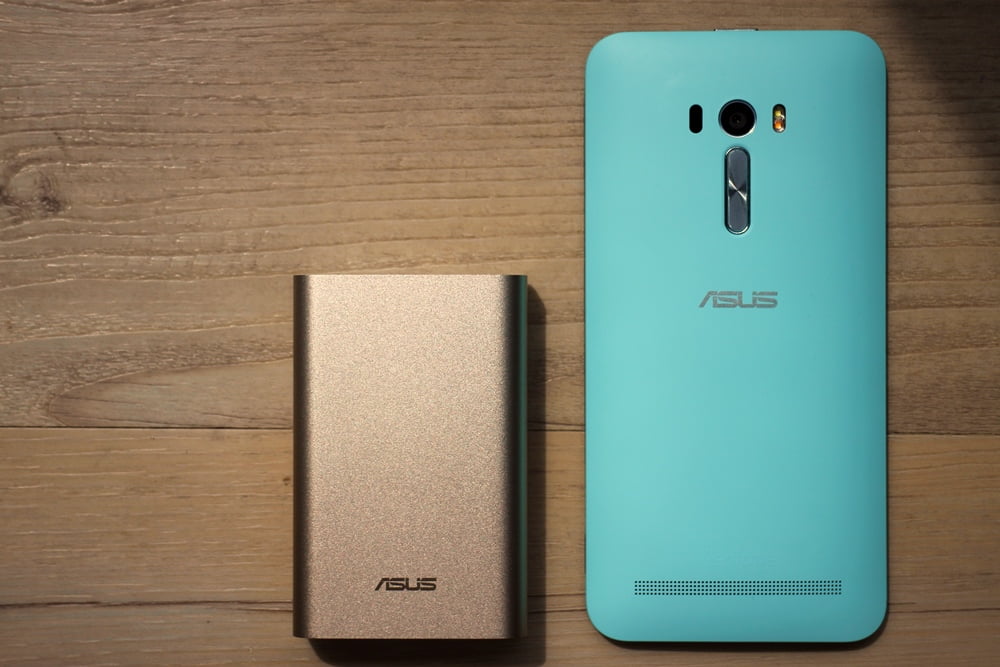
The recycled design from earlier this year has its share of pros and cons, but, thankfully, the latter aren’t anything close to a deal-breaker, except maybe for those with really tiny hands.
It looks and feels almost every bit like the ZenFone 2, only it has a laser-autofocus sensor and a large camera lens on the front.
Let’s start with the things the Selfie gets right: The candy-colored shell is incredibly smooth to the touch and doesn’t pick up fingerprints easily; the curved design makes the phone easier to grip than its thickness would indicate; and the lack of side buttons means you will never have to worry about accidentally pressing the either the power or volume buttons while holding the device in one hand.
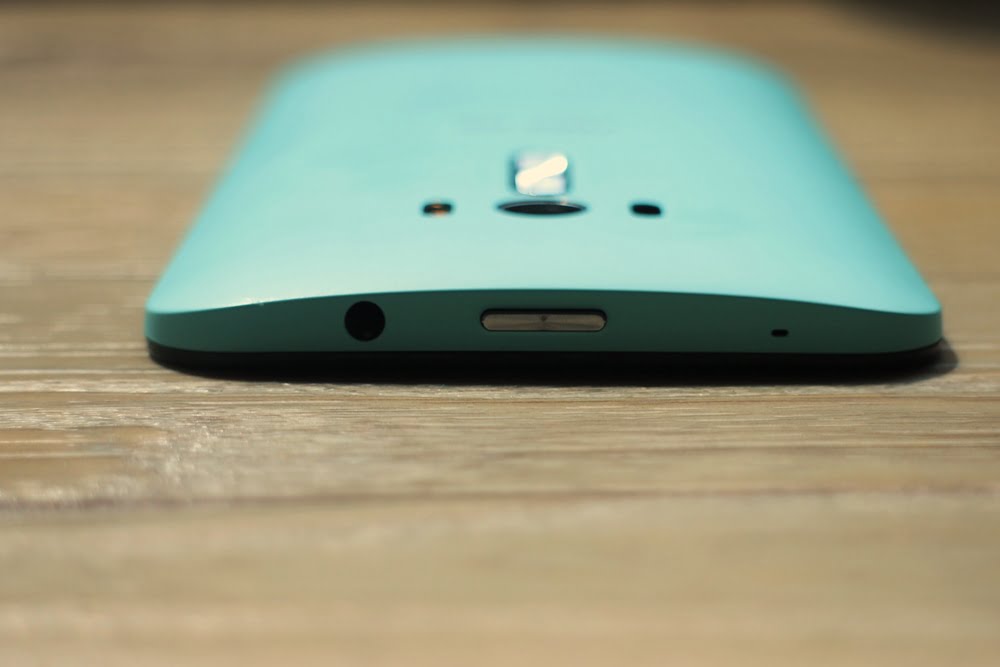
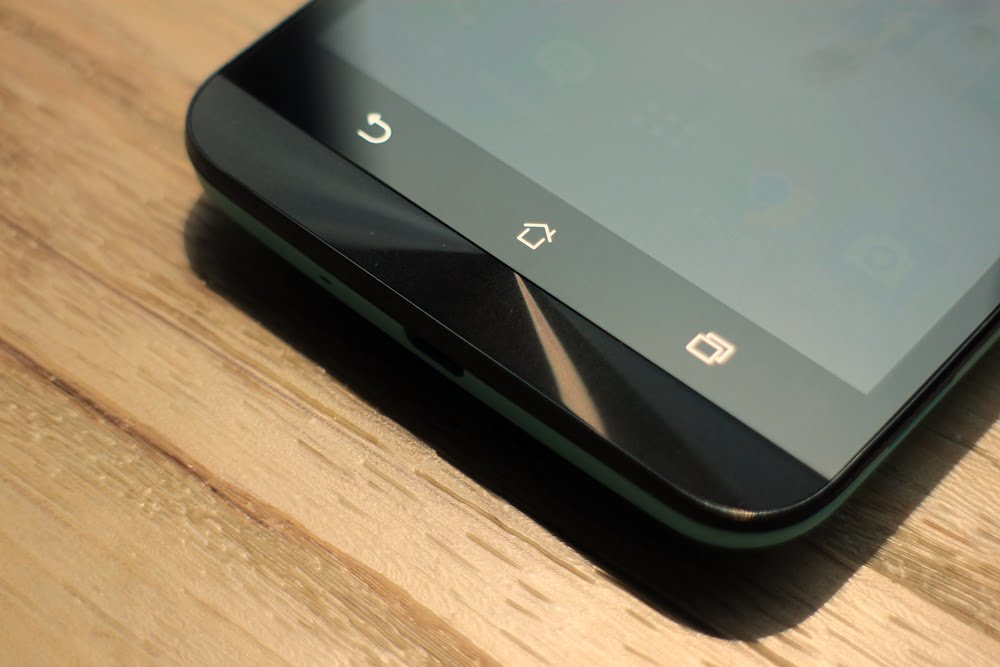
If I could change anything, it would be the Selfie’s display bezels: They’re unnecessarily thick, and they make the phone a bit taller and wider than it needs to be. As for the lack of backlighting on the navigation buttons and the slightly hard-to-reach power button located on the top edge of the handset, I found that I could live with these observations, which admittedly veer too close to nitpicking.
The Selfie’s IPS display matches that of the higher-end ZenFone 2 on paper, and I found it to be equally vibrant and, at 1080p resolution, just as sharp as well (same panel, perhaps?). It boasts a fast response time of 60 milliseconds, which serves to minimize motion blur and input latency, allowing for an even better usage experience as you tap and swipe through ASUS’ heavily skinned Android interface.
There doesn’t seem to be anything seriously amiss with its contrast balance and saturation, though the included Splendid app allows you to tweak the display to your liking.
If I could change anything, it would be the phone’s bezels: They’re thick, and they make the phone taller and wider than it needs to be.
The screen spans 5.5 inches diagonally, making it big enough to work on or share with a friend, all without compromising too much on portability. Which is good news, because chances are you’ll want to share the selfies you’ve taken with this phone. The only downside of the panel is that it’s set a bit too far behind the Gorilla Glass 4 frontage, which makes it difficult to see in direct sunlight. Otherwise, it’s really good for a phone this modestly priced.

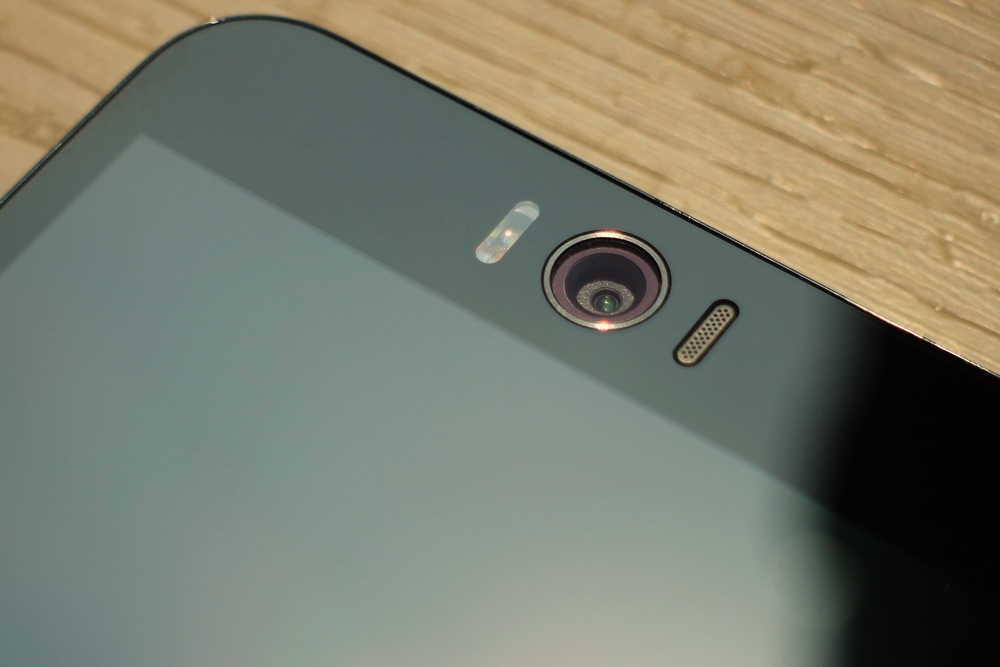
The Selfie makes use of nearly identical cameras that produce nearly identical results. And by that, I mean photos tend to look nice, regardless of which way the unit is facing. There are fixed cameras on opposite sides of the panel, both with 13-megapixel Toshiba sensors and dual-tone flash modules. The rear camera even comes with laser autofocus, just like the ZenFone Laser, OnePlus 2, and LG G4, for locking on to subjects with better accuracy and at a blistering pace.
Let’s start with the rear-facing camera, shall we? Under ideal lighting conditions, the images I captured using the rear-facer were crisp and mostly well-saturated. However, the same couldn’t be said of some of the stuff I took in Auto mode, as they were overexposed. I found low-light results to be pretty solid, though I would highly suggest shooting in Manual mode to control the ISO and shutter speed.
The Selfie makes use of identical cameras that produce identical results. And by that, I mean photos tend to look nice, regardless of which way the unit is facing.

The front camera has an aperture of f/2.2, as opposed to f/2.0 on the rear-facer, and a wide-angle lens to squeeze more people into a shot without resorting to using a selfie stick. Yes, taking the ultimate “groufie” is a fixture in the Selfie’s wheelhouse as well. The front-facing flash does a respectable job of making your mug look the best in poor lighting, and does so without making you look objectionable, or blinding you, in the process.
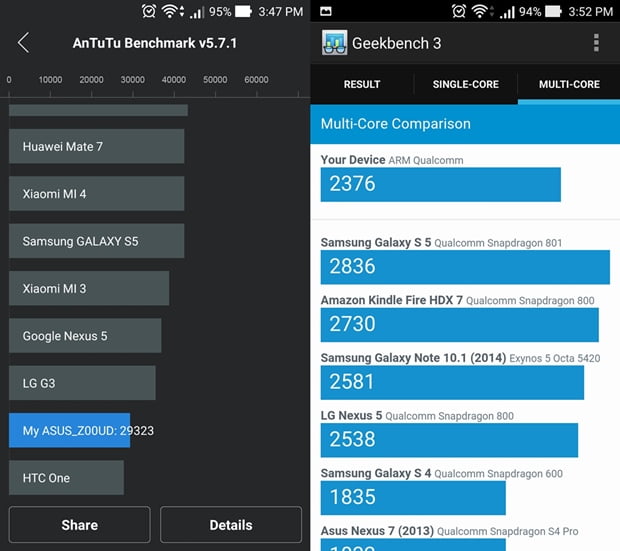
AnTuTu Benchmark (left) and Geekbench 3 scores (right)
The Selfie packs an octa-core Qualcomm Snapdragon 615 processor coupled with Adreno 405 graphics and a roomy 3GB of RAM, which is more than you’ll get on most handsets that retail for around $250. It runs a modified version of Android Lollipop in ZenUI and brings several advanced features and customization elements that will appeal to tech-savvy users.
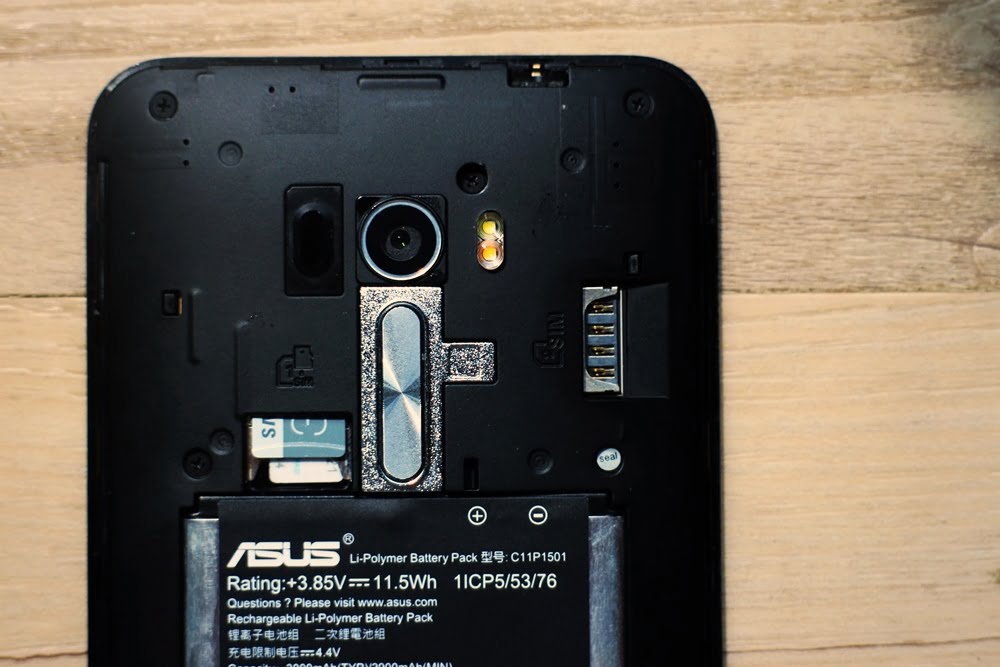
My favorite example of that integration between added functionality and freedom of choice is being able to install icon packs from third-party developers, which you could previous only get from custom Android launchers.
Inside, there’s an octa-core processor with a roomy 3GB of RAM, which is more than you’ll get on most handsets that retail for around $250.
The 32GB of built-in storage is probably plenty for most people. But if that doesn’t sound reassuring enough, I’m happy to report that it’s possible to expand the storage up to an additional 128GB using a microSD card. Elsewhere, the battery capacity sits at 3,000mAh.
After a week of using the Selfie as my daily driver, I have to say I’m impressed, even more so after factoring in its retail value. I found my review unit to be a solid performer that hits the sweet spot between everyday computing and moderate gaming.
It won’t break benchmark records, sure, and it won’t run the most demanding games consistently at high frame rates, but it should be plenty fast enough for the immediate tasks in front of it. And in case you’re wondering how the Selfie stacks up against the ZenFone 2, I didn’t find it any slower or any less responsive than the latter on most occasions.
I found my review unit to be a solid performer that hits the sweet spot between everyday computing and moderate gaming.
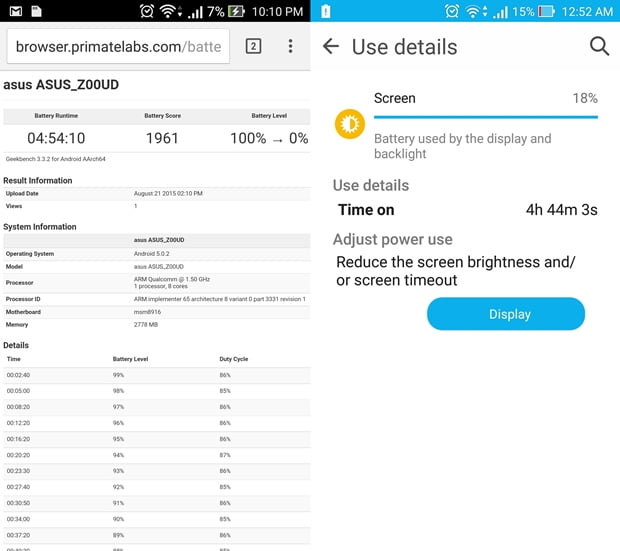
Geekbench 3 battery-test score (left)
Battery life is above average. But you wouldn’t be able to tell based on my battery-test result; Geekbench 3 awarded my test unit a score of 1,961 after lasting 4 hours and 54 minutes, which is somewhat low for a phone with midrange specs and a 3,000mAh cell. Those numbers proved to be inaccurate and are thankfully just, well, numbers. On most days, the Selfie made it through the entire day and had about 20 to 30 percent left before I hit the pillow.
The ASUS ZenFone Selfie lives up to the high standards set by the ZenFone it borrows plenty from. But to say that it’s merely a rehash of an earlier product, but with a really good selfie-taker that appeals to the narcissist in all of us, is lazy and unfair because it ignores everything else this phone does with great success.
Besides sporting a pair of above-average cameras, the Selfie offers a big, sharp display, fast system and network performance, decent battery life, and Android Lollipop, all while retailing for a very affordable P11,995.
To say the Selfie is a rehash of an earlier product, but with a good front camera, is lazy and unfair because it ignores everything else it does with great success.
Is it better than the ASUS ZenFone 2? I guess that depends on your definition of “better.” It takes better selfies, there’s no question about that. This phone is a veritable dreamboat when it comes to taking selfies, after all. However, if you’re looking for a portable gaming console that doubles as a cellphone every once in a while, then you’re probably better off with a ZenFone 2 in your pocket. Either way, you’ve ended up with a sweet deal.
Share this Post
Related video
Watch our ASUS Zenfone 2 review
Related articles across the web


Learn About This Author
