
As we hopped between airports, one story slipped past us: Omdia’s latest data confirms the trend we’ve been tracking — Transsion still dominates the Philippine smartphone space.

The market-research firm’s Q3 2025 report highlights how that lead may be showing cracks. Back in August, IDC’s Q2 numbers crowned Transsion with a staggering 39.7% share. Omdia’s latest figures prove that wasn’t a one-off.
If you thought the parent company of Infinix, TECNO, and Itel was just riding a lucky streak, think again. In the Philippines, it now commands 35% of the market. Put simply, more than one in three phones shipped here comes from its stable. The budget segment is effectively locked down.
The race for second place is far tighter. Xiaomi and Samsung are neck-and-neck at 13% each. Xiaomi edged out the South Korean giant for No. 2, likely thanks to aggressive POCO pricing, while Samsung climbed a spot to settle at No. 3.
Rounding out the top five are OPPO, which moved up to fourth place with 11%, and vivo, which slipped to fifth with 9%.
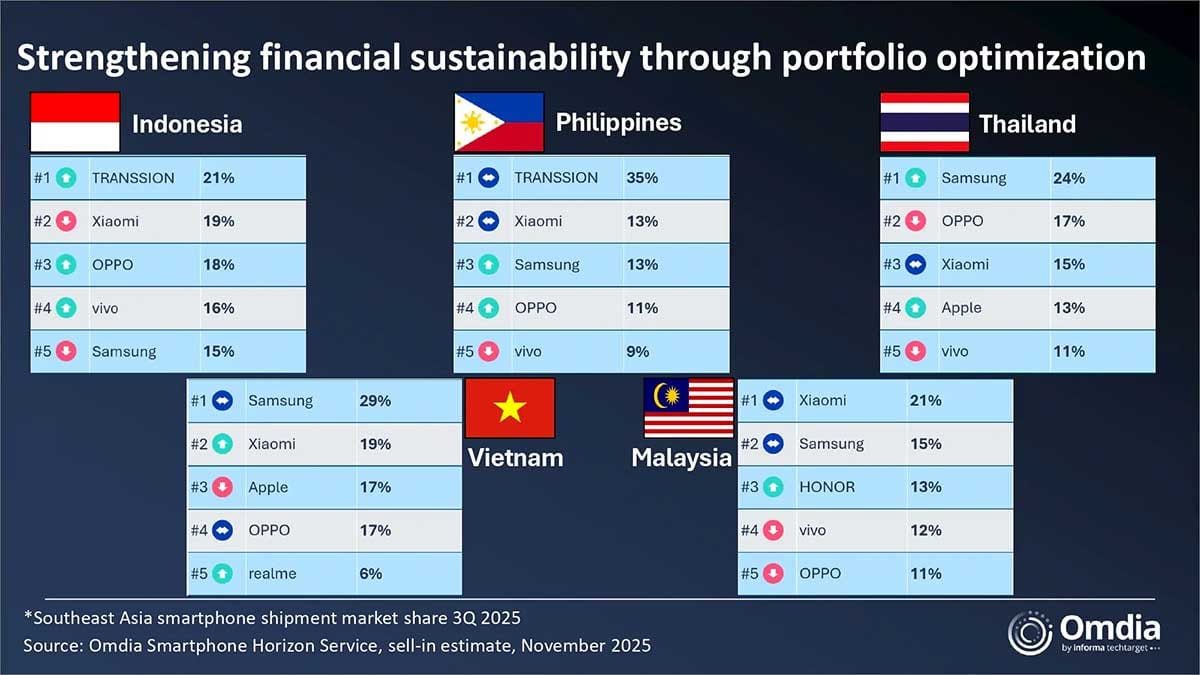
What’s striking is how the local picture diverges from the broader Southeast Asian scene. Regionally, Transsion and Samsung are tied at 18% each. In the Philippines, though, the dominance is far more one-sided.
So why are brands such as OPPO and vivo pulling in smaller shares now? Omdia says they are now prioritizing value over volume. Instead of battling in the bargain‑basement segment, they’re chasing profitability, choosing to push one solid midrange phone rather than flooding the market with a handful of entry‑level models.
The catch, even for Transsion, is that the aggressive pricing which secured its lead in the Philippines is now bumping up against economic reality.
Omdia warns of mounting cost pressures. Component prices, especially memory and storage, are rising. For the sub-$200 (under P11,703) bracket, which accounts for over 60% of Southeast Asia’s market, margins are razor-thin.
That leaves the current kings of the Philippine market in a bind. To hold onto that 35% share, do Infinix and TECNO raise prices and risk alienating the budget crowd? Or do they cut corners on hardware to keep that P6,999 ($120) price tag?
As we head into the holiday season, inventories look healthier, which usually means discounts. Enjoy the bargain bin while it lasts; the era of the “too good to be true” budget phone may be facing a reality check in 2026.
Share this Post
Learn About This Author