
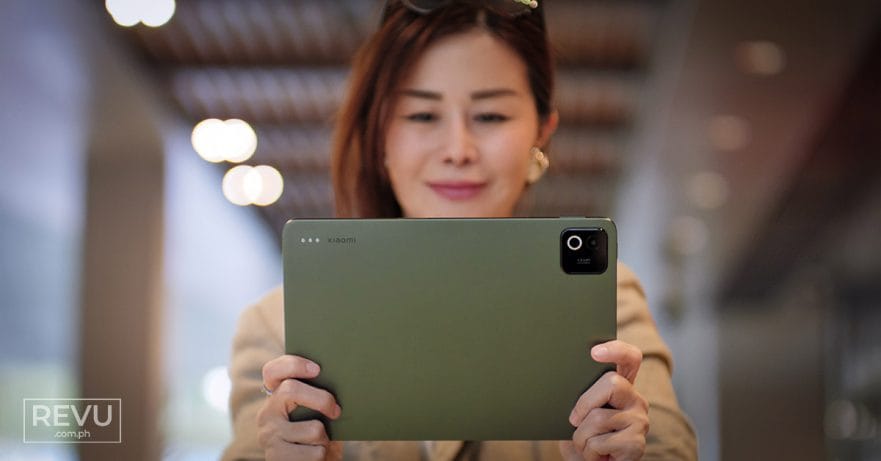
Xiaomi‘s latest tablet offering, the Xiaomi Pad 8, is here, and the company promises to pull no punches this time around.
Continuing the aggressive pricing strategy that made its predecessor a hit, this year’s iteration packs a much heavier punch where it counts: performance and endurance. Of course, Xiaomi is still also marketing this as a productivity machine — and the improvements, particularly on the inside, should help make that claim even more viable than in the past.
SEE ALSO: Xiaomi Pad 8 Pro, Pad 8 lead ecosystem expansion in the Philippines
With significantly more power under the hood and a larger battery designed to keep you streaming, gaming, and working well past standard business hours, the new Xiaomi Pad 8 is determined to make more expensive tablets look pretty much superfluous. But does it actually deliver on those lofty promises in the real world? Read on for our full review to find out.
@revuphilippines Flagship vibes. Midrange price. 🤯 Unboxing the Xiaomi Pad 8! 📦 It keeps the same 5.75 mm ultra-thin metal body and stunning 11.2-inch 3.2K display as the Pro model, but starts at just ₱20,999 in the Philippines. Find out more about the tablet and Xiaomi’s newest smart ecosystem accessories at www.revu.com.ph! #XiaomiPad8 #XiaomiLaunch #RevuDotComDotPH @Xiaomi Philippines @monch @Alora Uy Guerrero ♬ original sound – REVU Philippines
Our Xiaomi Pad 8 unboxing video
Impressively thin and ready to binge
If it ain’t broke, don’t fix it. That seems to be Xiaomi’s design philosophy here. The Pad 8 flaunts a premium metal unibody that is just a tad lighter and slimmer than the Xiaomi Pad 7 we reviewed last year.
In fact, if you put the two generations side by side, you’d be hard-pressed to notice a difference. The square camera module on the back with its single lens remains unchanged, and the overall dimensions are so identical that the official folio case for the Pad 7 perfectly accommodates the Xiaomi Pad 8.
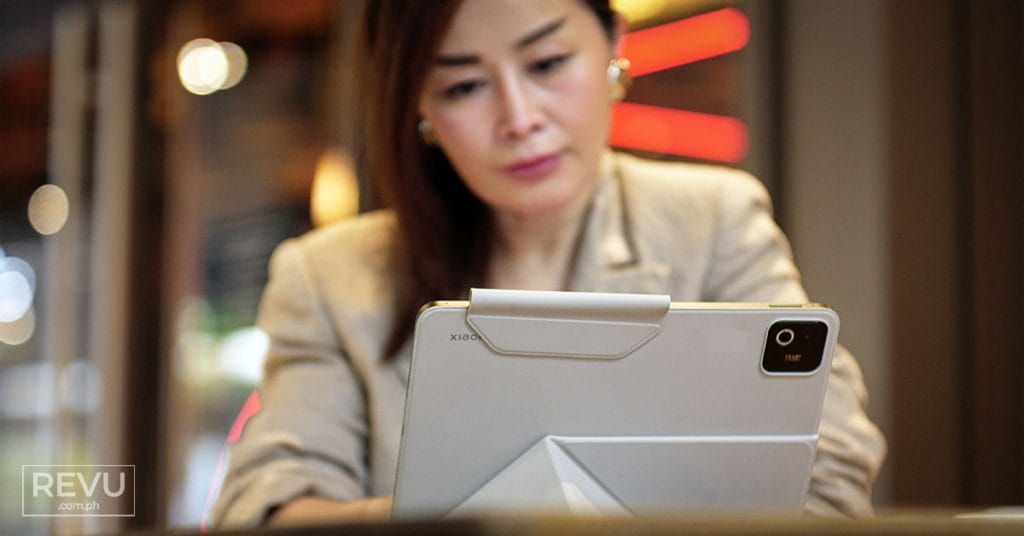
And that’s a good thing. By sticking to this blueprint, the brand’s latest slate retains the practical 3:2 aspect ratio that makes document work, web browsing, and reading a breeze. With a high screen-to-body ratio of 85.4%, the device looks undeniably modern, framed by sleek bezels and a cool aluminum shell.
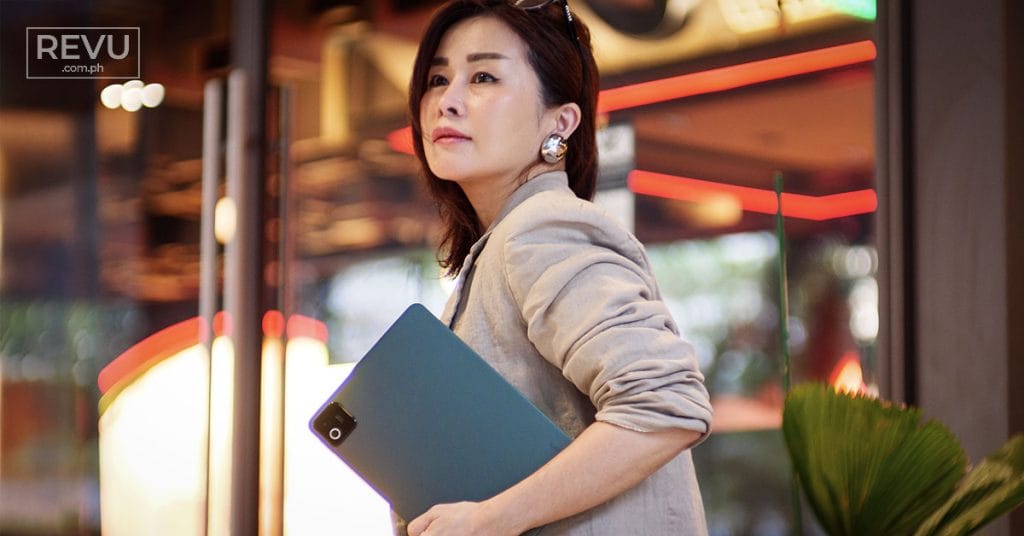
What really stands out, though, is the sheer thinness of the device. At just 5.75mm thick, it’s easily one of the slimmest tablets on the market — noticeably slimmer than most smartphones right now. Despite this impossibly thin profile, it weighs a manageable 485 grams, too, making it comfortable to hold for extended sessions and easy to carry on the move. It’s genuinely impressive that Xiaomi managed to shave off thickness while simultaneously upgrading the battery backup to a huge 9,200mAh cell.
Our unit came in Pine Green, featuring a matte finish that does an excellent job of hiding fingerprints. You can also pick it up in Gray or Blue. Perhaps the only real chink in its metal armor is the lack of an official IP rating for dust and water resistance, so you’ll want to be careful around the pool or tub.
When it comes to the screen, we know exactly what you’re here for — binging Netflix and powering through your favorite games. And the Xiaomi Pad 8 doesn’t disappoint on either front. While an OLED screen would have been a dream, we’re perfectly fine with its omission given the price point. Instead, you get a fantastic, flicker-free 11.2-inch IPS LCD display.
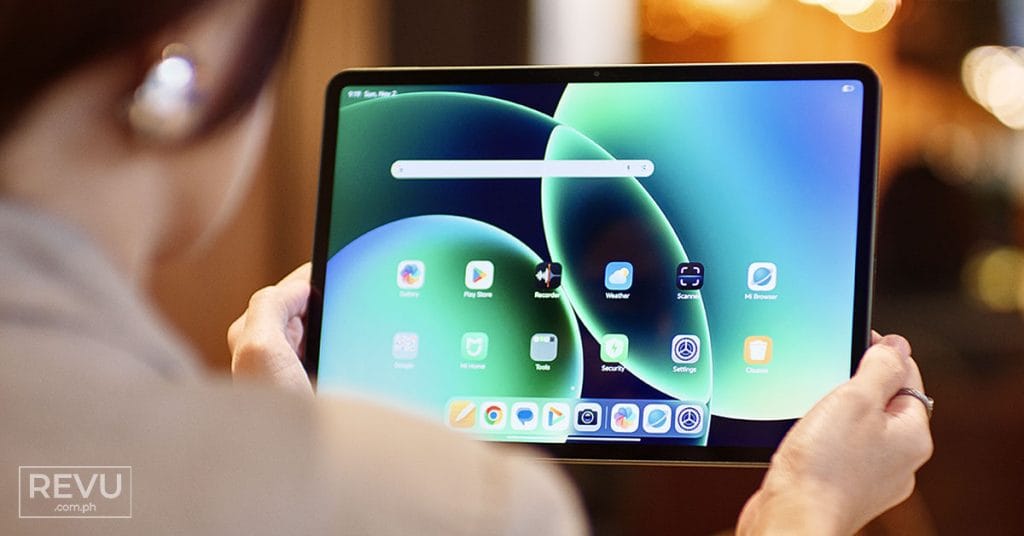
You’re looking at a 3,200 x 2,136 resolution, which translates to a crisp 344 pixels per inch. It feels incredibly fast, too, thanks to a 144Hz refresh rate. Better yet, the tablet is smart about how it uses that speed. If you leave it on the default setting, it dynamically shifts those refresh rates on the fly. That gives you buttery smoothness when you’re actively swiping and scrolling, while dialing things back to save power when you’re just reading a static website or document.
The panel pushes a peak brightness of 800 nits, according to Xiaomi. It’s plenty bright for most indoor use cases, delivering vibrant, accurate, and lifelike visuals thanks to a simulated 12-bit color depth. However, it will struggle to remain legible under direct sunlight, cementing the Pad 8 as more of an indoor companion than an outdoor one. It’s also worth noting that the 144Hz refresh rate is largely restricted to system UI navigation; your gaming frame rates will depend heavily on the title.
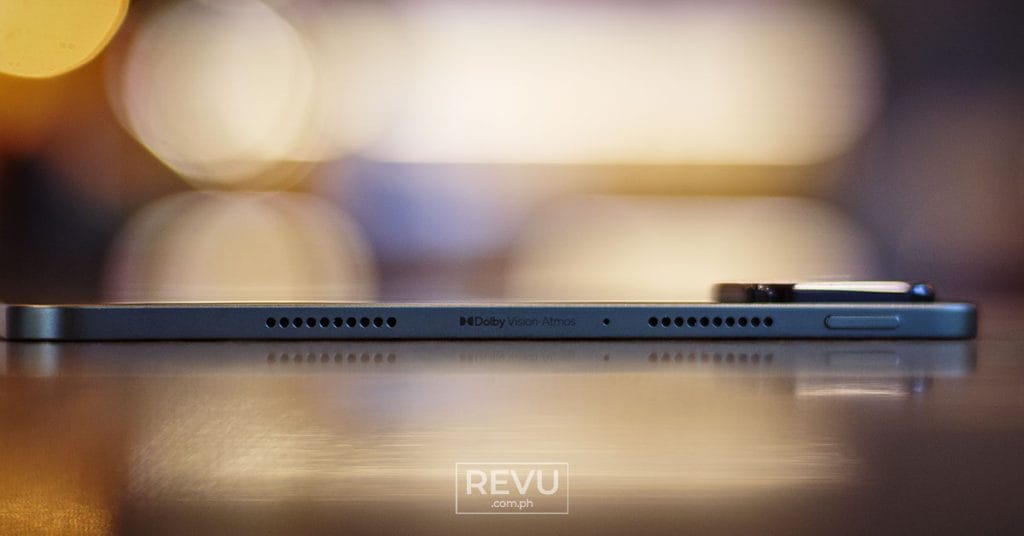
To complement the display, Xiaomi equipped the Pad 8 with a quad-speaker setup that supports Dolby Atmos. They sound great. The speakers get plenty loud and deliver clear, immersive audio that’s perfectly suited for movies and gaming. True, they lack the deep, room-shaking bass you’d get from a dedicated Bluetooth speaker or a high-end laptop, but for a tablet this incredibly thin, they’re more than sufficient for everyday media consumption.
Flagship speed, lasting endurance
Under the hood is where the Xiaomi Pad 8 really shines. The tablet upgrades to an 8-series chipset, specifically the Qualcomm Snapdragon 8s Gen 4. This alone is a significant leap over the Snapdragon 7 Plus Gen 3 platform found in last year’s model.
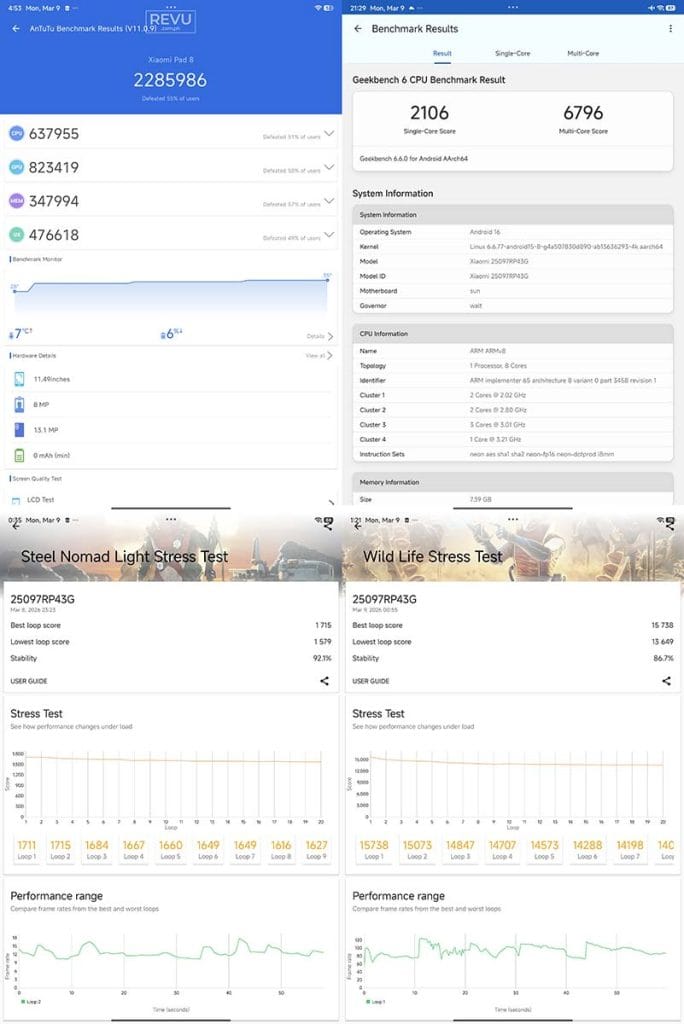
The synthetic benchmarks back this up. In Antutu V11, our unit — equipped with 8GB of physical LPDDR5X RAM and 256GB of UFS 4.1 storage — pulled close to 2.3 million points. That easily rivals flagship tablets from older generations. For context, our Xiaomi Pad 7 hovered around 1.3 million on an older version of Antutu. The Geekbench scores also echo this leap in raw power.
In real-world testing, the Xiaomi Pad 8 chewed through graphics-intensive games like GRID Legends, Deep Rock Galactic: Survivor (as you battle massive, constant hordes of alien insects), and the recent mobile port of 2013’s Tomb Raider without stressing the thermals. It passed various 3DMark stress tests with flying colors.

Xiaomi deserves a lot of credit for this one. For the first time, we’re looking at an entry-level slate from the brand that legitimately offers uncompromising, flagship-level power — and it manages to keep its cool while doing it.
Our only gripe? The global memory shortage is glaringly obvious here. The base model still starts at 128GB, which looks like a fantastic value on paper but is actually a ticking time bomb once you start downloading sizable apps. Even our 256GB unit feels claustrophobic for a 2026 powerhouse.
If you plan on emulating PC games — and the Xiaomi Pad 8 certainly has the grunt to run open-world blockbusters like Grand Theft Auto V or The Witcher 3 (we’re sure of it) — you’ll run out of room fast. If the company wants users to unlock this tablet’s full potential, they need to bump up the baseline storage and RAM next time around.
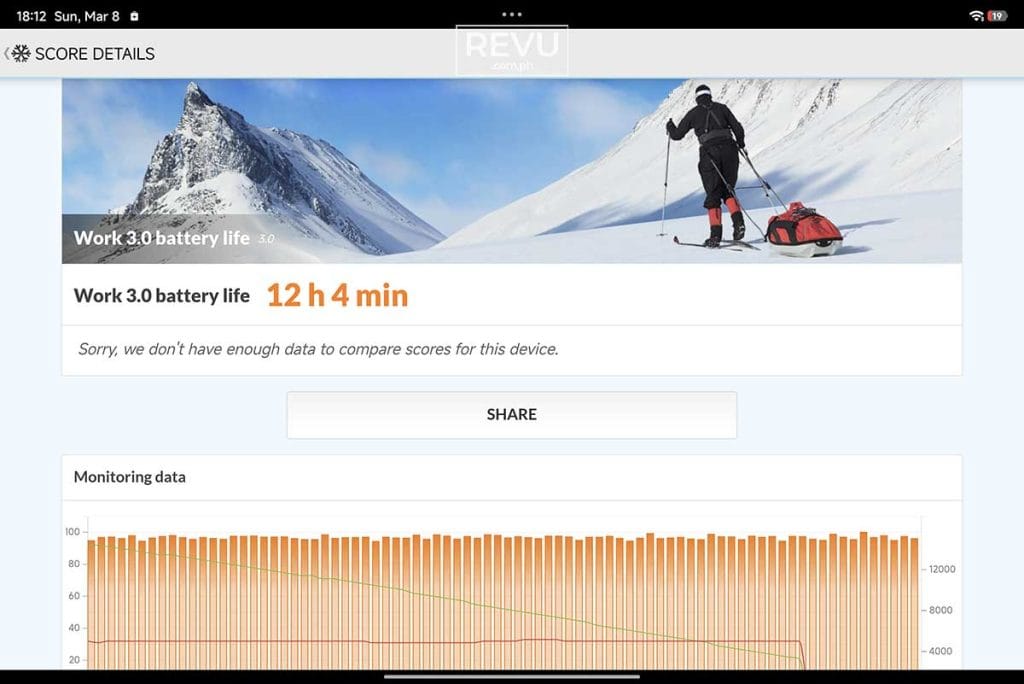
Thankfully, battery anxiety isn’t an issue. The dual-cell 9,200mAh battery is huge. In our PCMark battery rundown test, the device lasted over 12 hours, which is an admirable feat for an 11.2-inch display.
In terms of real-world numbers, streaming YouTube continuously over Wi-Fi for two solid hours at 50% brightness drained the battery by a measly 11%. Binging Netflix for another two hours under the exact same conditions sipped just 10%. Thanks to that incredible endurance, we only found ourselves reaching for the charger once every few days in normal day-to-day use.
The included 45-watt power brick takes the Pad 8 from zero to 100% in about 160 minutes. That’s quite a bit of a wait compared to other tablets in its class, but then again, with a battery this massive, we aren’t exactly surprised.
Desktop multitasking meets AI smarts
As usual, Xiaomi HyperOS 3 brings some notable productivity perks. The tablet comes preinstalled with a desktop-style native Browser as well as the desktop version of WPS Office. Xiaomi is also leaning heavily into AI this year, outfitting the Pad 8 with AI speech recognition, writing and illustration aids, an interpreter, a creativity assistant, and a handy AI calculator that solves handwritten equations.
For those who prefer a traditional laptop feel, Workstation mode is back. Flip a switch in the dropdown menu, and your apps instantly open in floating windows. You get desktop OS-style window stacking right on your device, retaining up to four open apps at once. Honestly, four is plenty; any more and the screen feels a bit too crowded. There’s also a standard split-screen view with a horizontal split ratio for maximizing your screen real estate.
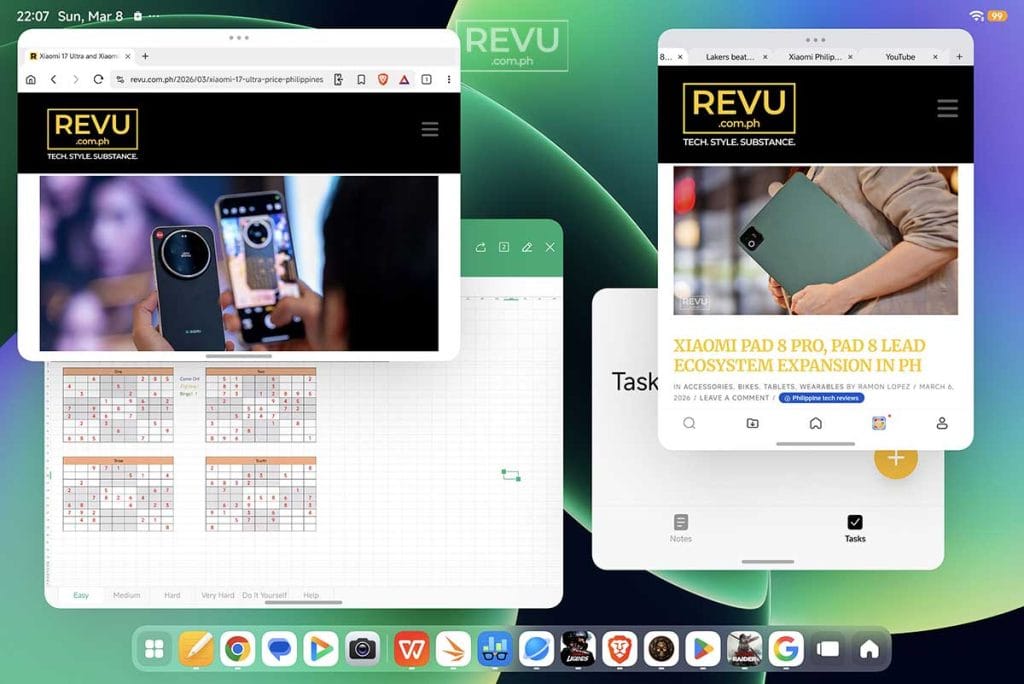
Pair the slate with Xiaomi’s official keyboard and a Bluetooth mouse, and things can get really productive. Just keep in mind there’s no SIM card slot here, so you’ll be tethered to Wi-Fi or your phone’s hotspot for remote work.
Final thoughts
While the Xiaomi Pad 8 might look identical to last year’s model, it improves exactly where it matters most. Beyond that crisp, color-accurate display, the tablet’s true strengths lie in its powerful processor and exceptional battery life.
It’s these internal upgrades that help the device mostly live up to its “mobile workstation” marketing. Sure, it lacks the sheer firepower of a high-end laptop, but it easily trades blows with midrange machines — all while significantly undercutting them on price (at least at the base tier). All things considered, it makes for a worthy productivity-centric travel companion.
In the Philippines, the Xiaomi Pad 8 starts at a very aggressive ₱20,999 (around $354 converted) for the Shopee-exclusive 8GB/128GB base configuration. However, if you want to avoid the storage constraints we mentioned earlier, the 8GB/256GB variant sits at a still-competitive ₱29,999 ($506). Even better, that price includes the Xiaomi Pad 8 Focus Keyboard right out of the box.
Xiaomi Pad 8 specs
- 11.2-inch 3.2K display, 3200 × 2136 resolution, up to 144Hz refresh rate
- 4nm Qualcomm Snapdragon 8s Gen 4 processor
- Adreno 825 GPU
- 8GB/12GB RAM
- 128GB/256GB storage
- 13-megapixel rear camera
- 8-megapixel front camera
- Xiaomi HyperOS 3
- 9,200mAh battery with 45-watt wired charging
- Color options: Pine Green, Blue, Gray
Learn About This Author
