
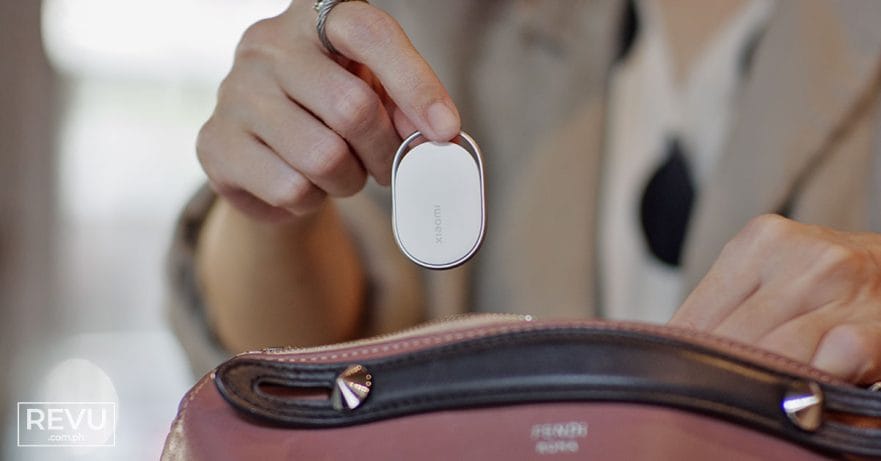
Be honest: If you’re deep in the Android ecosystem, watching Apple users quickly — and conveniently — track their lost keys with AirTags has probably stung a bit.

However, because AirTags are locked tightly behind Apple’s walled garden, you simply can’t use an Android device to register or track them.
Enter the newly launched Xiaomi Tag. The elevator pitch here is that it’s a budget-friendly, platform-agnostic alternative that finally levels the playing field for Android users — and yes, even those who don’t own a Xiaomi phone. Priced at just ₱899 (around $15) for a single piece, or an even more practical ₱2,799 ($47) for a four-pack in the Philippines, the company is aggressively targeting the sweet spot for the masses.
@revuphilippines We’ve unboxed peace of mind! Meet the Xiaomi Tag, your tiny but mighty tracker that keeps tabs on what matters most. 🔑 Keys, 🎒 bags, 💍 rings. Always find them fast. 🌍 The global launch happens on Feb 28. Will a new era of smart tracking begin? #XiaomiTag #XiaomiLaunch #RevuDotComDotPH www.revu.com.ph @Xiaomi Philippines @Xiaomi @monch @Alora Uy Guerrero ♬ original sound – REVU Philippines
Our Xiaomi Tag unboxing video
Under the hood, the specs are exactly what you want from a modern tracker. Equipped with Bluetooth 5.4, an accelerometer, and a loud built-in piezoelectric buzzer, it covers all the essential bases. What really makes it special, though, is its dual compatibility. That means it isn’t locked into a single ecosystem; the Xiaomi Tag plays well with Android devices via the Google Find Hub, and, notably, it also works flawlessly with Apple iPhones through the crowdsourced Find My network. In practice, this gives users the freedom to switch platforms without sacrificing functionality.
How does it work?
There’s no power-hungry, built-in GPS here. Instead, the Xiaomi Tag sends out a secure, encrypted Bluetooth signal. Any passing device on the Find Hub or Find My network can detect that ping and anonymously upload the tracker’s coordinates to the cloud. You then see that location pop up on your app.
And because this system leans on nearby smartphones rather than direct satellite positioning, it’s highly efficient. You don’t have to worry about the tracker draining your handset’s battery or eating up your data. When the device is far from your paired unit, it simply gives you an approximate ping based on the last known phone that walked past it.

You’ll also get a handy notification pinged to your smartphone if you happen to leave the Tag — and whatever it’s attached to — behind. The tracker’s remarkably low power consumption should make it an absolute godsend for vacations. The last thing you need while navigating a new city is the anxiety of keeping yet another battery-hungry gadget charged. Thankfully, you can preset up to 20 frequent locations, so your phone doesn’t blow up your lock screen every time you leave your bag on the couch.
Just keep in mind that it won’t ping both ecosystems at once. If you set it up on an Android, it solely looks for Find Hub devices. But if you pair it with an iPhone, it taps right into the Find My network, relying on the massive sea of Apple products out in the wild.
Setup and actual use
Pairing the Xiaomi Tag is dead simple. You just squeeze the tracker’s shell, which actually doubles as a giant physical button, for a few seconds, and hook it up to your handset via Bluetooth. We synced ours with a Xiaomi 17 and a POCO F8 Ultra, and the entire process took mere seconds. Over our testing period, the location accuracy was consistently spot-on.
Another incredibly useful feature is the ability to easily share the tracker’s location data with family and friends. If your keys are lost in the abyss of your partner’s car, they can track it on their end to help you hunt them down. On a much grander scale, if your checked bag goes MIA at the airport, you can share its ping with a travel buddy or a helpful airline staff member so they can help you locate the luggage while you handle things at the counter.
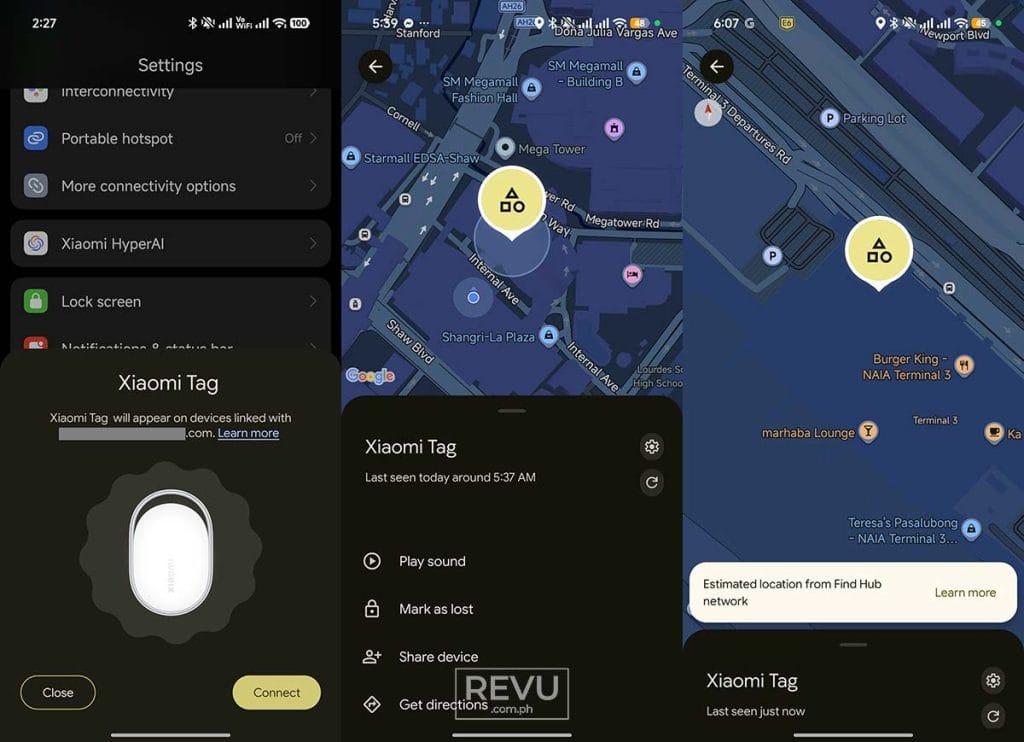
Speaking from experience as a team that frequently travels overseas for event coverages, we’ve lost more gear in foreign countries than we can count on one hand. It honestly makes us wish a cross-platform tracker like the Xiaomi Tag had been around back then.
We do have to address the UWB elephant in the room. Unlike the Apple AirTag, which uses Ultra-Wideband technology to give you those slick, on-screen directional arrows for “precision finding,” the Xiaomi Tag relies entirely on Bluetooth 5.4. What does that actually mean for you? It’s great for tracking down your luggage at the airport or your car in a mall parking lot. But when you’re two meters away from your keys hidden under a couch cushion, you won’t get any directional guidance on your phone. Instead, you’’ll’ll be relying purely on your ears and the Tag’s built-in buzzer.
Finally, we have to talk somewhat about privacy. Unwanted tracking is a massive concern these days, and thankfully, the brand hasn’t cut corners here. It has baked in industry-standard anti-stalking protections. If an unknown Xiaomi Tag is moving with you for an extended period, your phone — whether it’s Android or iOS — will automatically notify you.
Build quality and battery life
Physically, the Xiaomi Tag is a pretty unobtrusive little white disc. Weighing in at a feathery 10 grams, it doesn’t add bulk to your keychain or wallet. It’s also tough, boasting an IP67 certification for dust and water resistance, so getting caught in a sudden downpour or dropping it in a puddle (probably) won’t kill it.

Powering this lightweight tracker is a standard CR2032 watch battery, which comes preinstalled out of the box. Xiaomi claims you’ll get more than a year of juice out of it.
Obviously, it’s too early for us to definitively verify that claim. We only set our units up a couple of weeks ago right before flying out to (supposedly) cover Mobile World Congress 2026 in Barcelona, Spain. But the sheer convenience of just swapping in a cheap, readily available coin cell from the supermarket or online feels like a breath of fresh air. The last thing any of us needs is yet another gadget that requires a proprietary charging cable to worry about.
Final thoughts
Ultimately, the Xiaomi Tag is an affordable, reliable tracker that doesn’t punish you for your choice of ecosystem. And while you do trade UWB precision for broader compatibility, the mix of Bluetooth 5.4 and a loud buzzer should prove more than enough to find your gear in a crowded terminal. At just ₱899 ($15), the value is simply hard to ignore. That said, whether you’re a die-hard Android user or living in a split-platform household, it’s a no-nonsense investment that will no doubt earn its keep the very first time it saves you from panicking at the luggage carousel.

Learn About This Author
