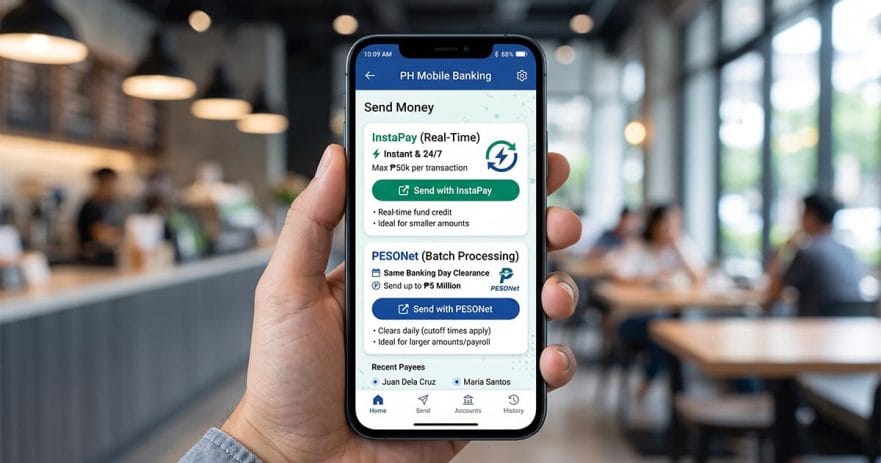
For years, moving money between banks in the Philippines came with a small but persistent toll. That standard ₱15 to ₱25 InstaPay fee might not seem like much, but if you’re splitting a dinner bill, paying rent, and topping up your e-wallet in one day, it quickly adds up.

Now, the barriers are coming down.
The Bangko Sentral ng Pilipinas (BSP) recently issued Circular No. 1238, a directive requiring financial institutions to strip profit margins from interbank transfers and charge only the actual “switch cost.” When Bank of the Philippine Islands (BPI) responded by dropping both InstaPay and PESONet fees to zero, it set off an industry-wide chain reaction.
If you’re tired of paying to move your own cash, here is a breakdown of who is following BPI’s lead, who is hedging, and what catches you need to watch out for. Take note that this list will be updated periodically as more banks and e-wallets adjust their policies.
The traditional banks removing the fees
Legacy banks have historically been the most resistant to giving up transfer fees. Now, momentum is building.
- Land Bank of the Philippines. The state-owned heavyweight didn’t hesitate. Following BPI’s July 1 announcement, Landbank scrapped both InstaPay and PESONet fees on July 7. There are no minimum transfer amounts and no monthly quotas. It’s just free.
- Union Bank of the Philippines. UnionBank, already known for having one of the most robust digital platforms among the legacy banks, officially joined the zero-fee club on July 7. The bank eliminated its ₱10 InstaPay charge for all transactions made through the UnionBank Online app. Since UnionBank’s PESONet transfers were already free, this move makes moving money out of a UnionBank account entirely cost-free for the average consumer.
- Metrobank. Joining the zero-fee wave on July 9, Metrobank stripped away its transfer fees for both InstaPay and PESONet. The only guardrails to keep in mind are the standard digital limits: InstaPay transactions are capped at ₱50,000 per transfer, while PESONet transactions have a ₱200,000 daily limit.
- BDO Unibank. In a huge turn of events, the country’s largest bank has apparently caved to the pressure. On July 9, users noticed that BDO dropped its InstaPay and PESONet fees to ₱0 when transferring money via the BDO Online and BDO Pay apps. While it’s technically a developing story as consumers wait for the official corporate PR announcement, the app receipts don’t lie; the fee is gone.
- Chinabank. Chinabank officially cut its ₱5 transfer fee down to ₱0 on July 9. Customers can now send money completely free via InstaPay and PESONet as long as they route the transaction through the newly updated My CBC App.
- PSBank. Keeping pace with its parent company (Metrobank), PSBank also made its move to zero on July 9. Digital transfers via PSBank Mobile/Online are now completely free, subject to a ₱50,000 daily limit for InstaPay and a ₱200,000 daily cap for PESONet.
- RCBC (with conditions). RCBC eliminated its InstaPay fees on July 4, but the fine print matters; the bank is using this as leverage to direct traffic to specific apps. Your experience entirely depends on where you log in:
- RCBC Pulz app. You get 30 free transfers per month, but only if each transaction is at least ₱100. Send ₱99 or hit your 31st transfer, and the old ₱10 fee kicks in.
- DiskarTech app. Unlimited free InstaPay transfers with no minimum amount. You get unlimited free InstaPay transfers with no minimum amount. However, PESONet transfers will still cost you ₱10 here.
The e-wallet duopoly: Cheaper, but not free
The country’s biggest digital wallets — GCash and Maya — are taking a different approach. Instead of waiving fees entirely, they’ve trimmed costs to comply with BSP’s pricing caps.
- GCash. The market leader cut its InstaPay fee from ₱15 to ₱10 on July 4.
- Maya. Maya followed suit on July 6, lowering InstaPay fees to ₱10. The upside? PESONet transfers remain free, making Maya the better option if you can wait for batch clearing.
The legacy holdouts
Not every institution is rushing to abandon transfer fees. Some major players, like Security Bank, continue to maintain their charges. Unless you’re a high-net-worth Gold Circle or Wealth client, standard account holders still pay ₱25 per InstaPay transfer — one of the highest fees in the market.
It’s a notable contrast to BPI’s zero-fee move and highlights how divided the traditional banking sector remains. While some banks are embracing BSP’s directive with aggressive fee cuts, others are taking a more cautious stance, signaling that the transition to a fully fee-free environment is far from uniform.
The digital banks already living in the future
While traditional banks and e-wallets are making headlines now, digital-only challengers have been offering free transfers for some time — a strategy to attract and retain users.
- The unlimited zero-fee club. Banks like CIMB, UnionDigital, Tonik, UNO Digital Bank, and OwnBank charge ₱0 for both InstaPay and PESONet. No quotas, no minimums, no catches.
- The quota gang. Some digital banks balance user acquisition with cost control:
- MariBank. You get a generous 50 free transfers a month (combining InstaPay and PESONet). Burn through those, and you’re hit with a ₱15 processing fee per transaction.
- GoTyme. You get 15 free transactions per week (combining both InstaPay and PESONet). After that, you’re back to paying ₱15 per transfer. The counter resets every Monday.
- SeaBank. Similar to GoTyme, you get your first 15 transfers free every week.
What it means for you
The BSP’s directive represents a structural shift in how Filipinos move money. For consumers, the immediate benefit is clear: lower costs and, in many cases, free transfers. For banks and e-wallets, the challenge lies in balancing compliance with profitability, especially as digital adoption accelerates.
This move also aligns with the BSP’s broader push for financial inclusion and a cash-lite economy, where digital transactions become the norm rather than the exception. With more than 80 million Filipinos now using e-wallets and online banking, the removal — or reduction — of transfer fees could further accelerate the shift away from cash.
Here’s how the landscape looks right now:
- Winners. Consumers, particularly those juggling multiple transfers daily.
- Fast movers. BPI, Landbank, UnionBank, Metrobank, BDO, PNB, Chinabank, PSBank, and the digital bank ecosystem offering unlimited free transfers.
- Cautious players. RCBC, GCash, and Maya, which are lowering fees or adding conditional strings, but haven’t fully embraced unrestricted zero-fee banking.
The BSP has made its stance clear: Moving your own money shouldn’t feel like paying a toll. Whether the rest of the industry fully embraces zero fees or continues to hedge will determine how seamless, and affordable, digital finance in the Philippines becomes.
(UPDATED ON JULY 9)
Learn About This Author