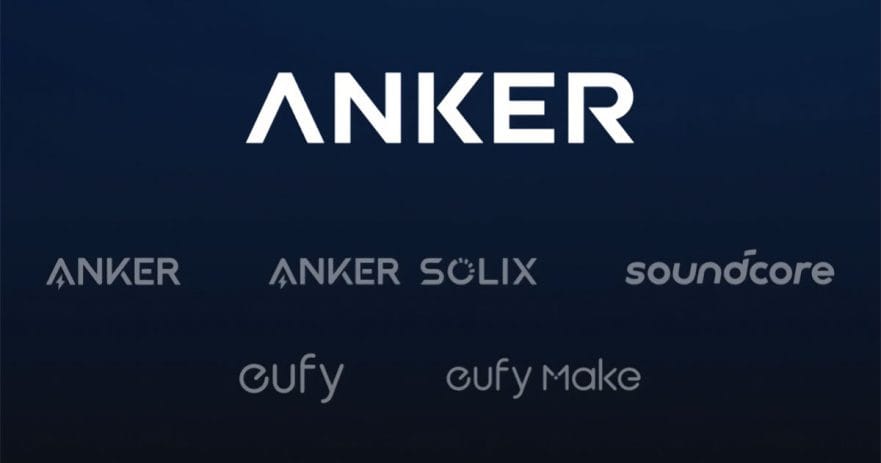
For nearly 15 years, Anker Innovations has built its technology empire through a collection of specialized brands: Soundcore for earbuds and headphones, Eufy for robot vacuums and security cameras, Solix for home energy, and EufyMake for creative tools. Now, it’s pulling them all under one roof.
The consumer technology company is unifying its five brands under a single name: Anker.
Unveiled at IFA 2026, the move is a major reset for a company that spent years deliberately separating its products by category. Anker says that strategy made sense when charging, audio, smart-home devices, and other technologies largely lived in their own lanes. But with AI, robotics, local computing, and connected devices increasingly overlapping, those lines are getting harder to draw.
And so, Anker is simplifying things. Its products will now fall under two broad groups: “Anker For You,” covering charging, audio, personal health, and creative tools; and “Anker for Home,” covering home security, robotics, and home energy.
For a company that has grown to more than 200 million customers across over 180 countries and regions, that’s a pretty significant change. Anker is also using the rebrand to show off a new generation of hardware built around the idea of a more connected, more intelligent ecosystem.
Anker unifies its brand
Charging gets smarter
Leading the portable charge is the MagGo Power Bank Pro 2, an actively cooled magnetic power bank with built-in dual air ducts and a miniature fan. Anker says the system keeps the battery below 36 degrees Celsius while charging. It likewise supports 25W Qi2.2 magnetic wireless charging, with Anker claiming it can take an Apple iPhone 17 Pro from 0% to 50% in 25 minutes. A smart display shows real-time power, temperature, and remaining charging time.
There’s also the MagStand Charging Station, which combines a 25W magnetic charging pad, retractable cable, and hidden USB-C port. Its Care Mode is designed to slow overnight charging and finish around the user’s alarm rather than simply topping up as quickly as possible.
For desks, Anker has a USB-C hub capable of driving dual displays at up to 240Hz, complete with a built-in 2-inch screen showing power, temperature, and port status. And for travelers, the Nano Universal Charger packs international plugs for more than 200 countries and regions, with four-device charging and up to 100W through each USB-C port.
THUS AI moves into audio
Anker’s bigger audio play is its proprietary THUS AI chip, a Neural-Net Compute-in-Memory design that handles AI processing directly on the device. The chip now powers the AeroClip 2 Pro, an on-ear clip-style pair of earbuds that can record meetings, calls, and conversations before transcribing and summarizing them. The standard AeroClip 2 uses the same chip and form factor.
The Liberty Buds 2 take a more conventional in-ear approach, with an eight-sensor array for calls and 9.2mm drivers for music and video.
Then there’s Anker’s growing obsession with sleep. The Sleep 4 and Sleep 4 Pro continue the company’s sleep-earbud lineup, with the Pro adding PPG-based heart-rate and HRV monitoring alongside dynamic audio designed to adapt to the user’s sleep.
The more unusual products are the SleepLab and SleepLab Pro, Anker’s first sleep-focused bedside speakers. The Pro model uses 60GHz radar to track breathing and heart rate and analyze the four stages of sleep, then adjusts its audio accordingly — without requiring earbuds, a ring, or another wearable.
MindBase is the bigger bet
The most ambitious announcement, though, is Anker MindBase. Think of it as Anker’s attempt to put a local AI brain at the center of the smart home. Rather than sending every task and piece of household data to the cloud, MindBase is designed to connect devices, run AI locally, and store data inside the home.
It supports Matter-compatible devices and works alongside Apple HomeKit, Amazon Alexa, Google Assistant, and Home Assistant. It can also be expanded to as much as 48TB of local storage for things like security footage, family photos, and other household data.
Anker essentially breaks MindBase into three parts: connection, intelligence, and memory. The first brings Anker and compatible third-party devices into one system. The second uses dedicated AI agents to handle tasks such as security and network storage. The third keeps the household’s data stored locally.
That’s where the company’s new MindBase Security Kit comes in.
The system includes the TrackLight Cam S1, a 4K telephoto camera with an auto-tracking light, and the Video Doorbell S4, which offers a 180-degree panoramic view. There are entry and motion sensors, too, while Smart Security Shield uses 180-degree dual radar to detect movement. DSKey technology, meanwhile, can recognize friends and family from up to 30 meters away.
MindBase isn’t the only security hardware coming. Anker introduced the NVR Security System E50, Window Camera E10, and Fall Detection Sensor as well.
On the cleaning side, there’s a new robot lawn mower and the Robot Vacuum Omni E35, which brings 35,000Pa suction and a HydroJet 2.0 self-cleaning roller mop. The E35 has also earned TÜV certification as a “Maternal and Infant Cleaning Robot” based on criteria including bacterial elimination, noise levels, cleaning performance, and self-cleaning.
What happens to Eufy and Soundcore?
For existing users, the transition shouldn’t happen overnight. Anker says current products will gradually move to the Anker name, while warranties, customer support, and service remain unchanged. HomeBase S380 users will also be able to transfer their existing footage to a new MindBase hub.
That gradual approach matters. Anker isn’t asking millions of existing customers to suddenly forget the brands they’ve bought for years. Instead, the company is betting that the next generation of products can make the Anker name familiar across categories.
For Filipino consumers, that transition starts taking shape soon. Anker Philippines will officially launch its “ONE ANKER” campaign on Sept. 22, when it’s expected to share more about the local rollout and what’s coming next.
The interesting part isn’t really the name change. Anker is betting that charging, headphones, cameras, robots, batteries, and AI don’t need to be separate products anymore. If the company can actually make all of those things work together, “Anker” could end up meaning a lot more than a charger.
Learn About This Author