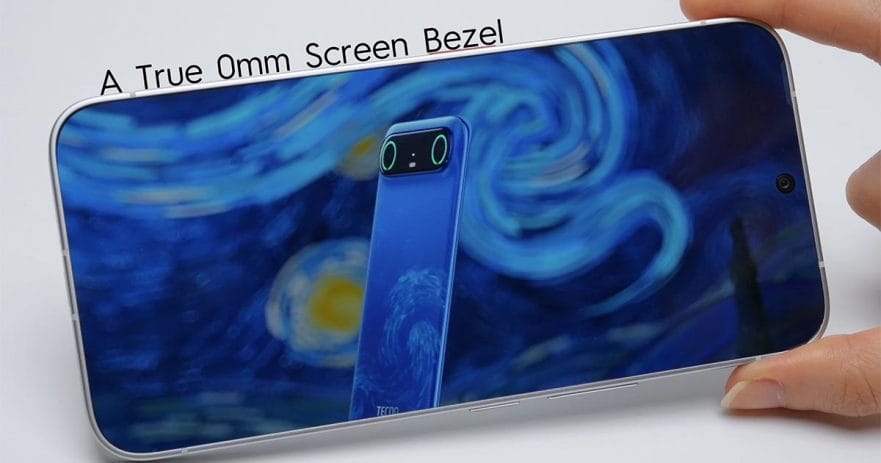
We’ve been chasing the all-screen smartphone dream for the better part of a decade. From the curved edges of older Samsung Galaxy models to the razor-thin borders of the latest Apple iPhone 17 Pro, the technology industry has little tolerance for a black border. Now, TECNO Mobile, a brand many Filipinos know best for aggressively priced budget phones, teases it has finally eliminated the bezel.

Meet the “Next-Gen Borderless Concept Phone.” According to the Chinese manufacturer, it boasts a “true 0mm-bezel display.” No ultra-thin borders, no tricks with waterfall curves that distort the edges of your videos. Just pure, unadulterated screen from edge to edge.

The prototype is set to make its public debut at the IFA 2026 tech trade show in Berlin, Germany, this September. But as with any ambitious concept, there’s a lot to unpack between the sleek marketing renders and real-world viability.
The TECNO Next-Gen Borderless Concept Phone teaser
So how did TECNO achieve a 0mm bezel? Right now, most flagship phones hover around 90% to 95% screen-to-body ratios. To hide that last remaining millimeter of bezel, manufacturers usually resort to curving the glass or aggressively shrinking the internal wiring.
The Transsion Holdings sub-brand claims it achieved its literal 0-micron border through a mix of new engineering techniques:
- Advanced internal stacking: Reorganizing the internal components to clear up space along the extreme edges of the device.
- New screen packaging techniques: Altering how the display panel itself is sealed into the chassis.
- Structural re-engineering: Shaving off the final millimeter typically reserved for internal circuitry and safety clearances without compromising the phone’s integrity.
Essentially, TECNO figured out how to cram the display circuitry inside without needing a visible black frame to hide it. Based on early comparison images released by the company (where it cheekily placed the device next to what appears to be an iPhone), the difference is stark. The smartphone features a flat display, a standard punch-hole cutout for the selfie camera, a USB-C port, and a mysterious red button on its slim left edge.
Check out the third image above. That’s an Apple iPhone next to the TECNO Next-Gen Borderless Concept Phone, isn’t it?
The back of the handset, along with actual specifications like the processor and battery capacity, remains unknown.
What could be the catch? Here is where we need to take a step back and look at the physics of a truly bezel-less phone. It looks incredible in a press render, but living with one poses two problems that are hard to solve:
- Where do your fingers go? When you hold a smartphone, your skin naturally wraps around the edges. Bezels, as much as we hate looking at them, serve a practical purpose as a “dead zone.” Without them, your fleshy palm is constantly touching active pixels. Apple and Samsung spend millions perfecting software palm-rejection to prevent accidental inputs. TECNO will need to prove its software is smart enough to differentiate between a deliberate tap and the natural grip of your hand. If not, navigating the OS will be a nightmare of ghost touches.
- The drop-test anxiety: The bezel also acts as a physical shock absorber. If a 0mm-bezel mobile lands on its side, the impact transfers directly to the display panel. Without a buffer, the risk of a shattered screen skyrockets.
Then again, we at REVU Philippines believe this development matters for the smartphone market.
TECNO isn’t just making noise for the sake of it. The brand has been steadily climbing the ranks in emerging markets, transitioning from a budget-only player to a company pushing genuine innovation, like its previous rollable screen concepts and pop-out portrait lenses.
This 0mm-bezel prototype is a halo product. It’s a statement piece meant to prove that TECNO can go toe-to-toe with the design chops of the industry heavyweights. Even if this specific device never hits store shelves, the “distinct design language” it pioneers will likely trickle down to the company’s consumer lineups in the coming years, offering a flat, edge-to-edge alternative to curved displays.
If TECNO can solve the accidental touch and durability puzzles, we might actually be looking at the final form of the modern smartphone. We’ll find out just how practical it is when the device hits the show floor at IFA next month.
Learn About This Author