
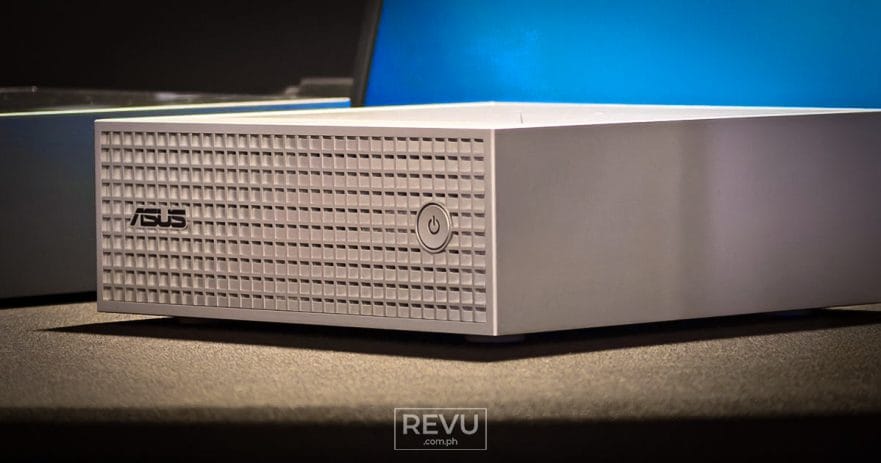
During a recent ProArt seminar here in the Philippines, we spent some time to check out the new ASUS ProArt GR1X. It’s one of the first mini desktops to emerge from Nvidia‘s consumer-focused RTX Spark platform, though calling it a “mini desktop” is probably an understatement.

Packed in a chassis roughly the size of a sandwich (measuring just 150 x 150 x 51mm, for those curious), it’s engineered to bring heavy AI supercomputing capabilities straight to your desk.

But before we dive into the silicon, let’s talk price. An ASUS representative we spoke with on the ground indicated that the ProArt GR1X should arrive locally at about ₱260,000 (around $4,160) for the base model. That starting configuration includes 64GB of unified memory. It’s expensive, sure, but it’s a bargain considering the price of the similarly specced ASUS Ascent GX10, which starts at ₱422,000 ($6,752) in the Philippines.
Inside, the ProArt GR1X runs on Nvidia’s RTX Spark platform, otherwise known as the N1X chip. You’re looking at a Blackwell RTX GPU equipped with 6,144 CUDA cores (not a typo!) and fifth-gen Tensor cores purpose-built for FP4 workloads, sitting alongside a 20-core ARM-based Grace CPU. The two are bridged by a lightning-fast NVLink-C2C connection, pulling from a shared pool of up to 128GB of unified LPDDR5X memory. Connectivity is equally modern, featuring 10 Gigabit Ethernet, Wi-Fi 7, Bluetooth 5.4, and Gen 5 storage.
To keep the entire setup from melting down under heavy loads, ASUS built a precision dual-fan thermal system utilizing 218 fan blades. It offers roughly 140 watts of thermal headroom, specifically designed to handle sustained 24/7 inference tasks while remaining quiet. Performance-wise, ASUS is marketing up to 1 Petaflop of FP4 AI performance. If you’re running dense BF16 tasks, however, expect real-world throughput to hover closer to a still-impressive 60 teraflops.
We got a closer look at the recently held ASUS ProArt GR1X at ASUS ProArt Creator Connect Manila 2026
Everything runs on Microsoft Windows 11 on ARM. But there’s a catch.
One critical spec is noticeably absent from the official spec sheet we saw: memory bandwidth. When you’re running local large language models or LLMs, the GPU compute isn’t usually your primary bottleneck — the memory pipe is. Memory bandwidth dictates the model’s decode speed, which essentially determines how fast the AI can type out its responses. Without that published figure, we still don’t know if a heavy model on the ASUS ProArt GR1X will generate text faster than you can read, or if it’s going to chug along at a slideshow pace.
So, who exactly is dropping a quarter of a million pesos on this?
For AI developers who rely on Nvidia’s software, the GR1X sounds like a dream. Creative professionals — think video editors, 3D renderers, and artists looking to accelerate their workflows with local AI — are the other clear demographic. That is, assuming their plugins are ready for Windows on ARM, though, as we’ve seen with PCs based on Qualcomm’s Snapdragon X2 processors, Adobe is already rebuilding its suite natively for the platform.
Those potential caveats aside, the ASUS ProArt GR1X’s biggest advantage is its shared memory design. By packing the CPU, GPU, and memory into a single package, it eliminates the lag that typically occurs when moving data between separate PC parts. That generous 128GB memory pool means you can run 120-billion parameter AI models entirely offline. Better yet, you’ll still have enough horsepower left over to handle complex video editing and image generation simultaneously. And impressively, all of this AI supercomputing power is housed in a device that can squeeze into tight spaces or under a monitor.
ASUS ProArt GR1X specs
- 150 x 150 x 51mm (1.1-liter) compact chassis
- NVIDIA RTX Spark Superchip featuring a 20-core NVIDIA Grace CPU
- NVIDIA Blackwell RTX GPU (6,144 cores, up to 1 petaFLOP FP4 AI performance)
- Up to 128GB LPDDR5X unified memory
- PCIe Gen 5 storage
- Wi-Fi 7, Bluetooth 5.4, and 10 Gigabit Ethernet (LAN)
- 1x HDMI 2.1, 3x USB 3.2 Gen 2×2 Type-C (DisplayPort 2.1), 1x USB 3.2 Gen 2×2 Type-C (Power Delivery in)
- Microsoft Windows 11 on ARM
- Precision dual-fan thermal design (218 blades, 4 heat pipes, 140W TDP)
- Color options: Black (anodized finish) or Silver (precision-sandblasted finish)
Learn About This Author
