
September 2026 has raised the bar for Android device performance. Proprietary silicon is challenging established chipmakers, flagship devices are approaching the 5-million-point milestone, and MediaTek is dominating the sub-flagship segment. For anyone planning a hardware upgrade ahead of the holiday season, here’s a closer look at how the top-performing Android smartphones and tablets rank in Antutu’s latest benchmark data for devices released in China.

Top 10 flagship smartphones: Xiaomi’s custom silicon takes the lead
Qualcomm’s dominance in the ultra-premium market is facing a new challenge. After leading the performance charts for much of the year, the Snapdragon 8 Elite Series now faces growing competition from Xiaomi’s proprietary Xring O3 chipset.
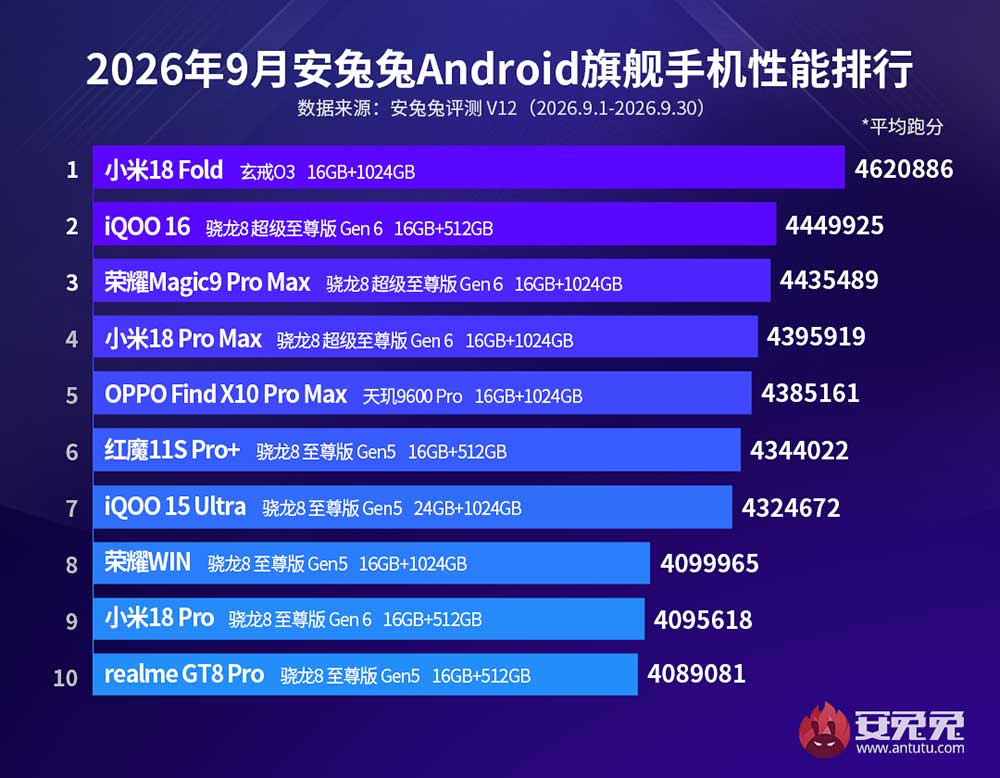
The latest rankings highlight a shift in the distribution of raw processing power. The Xiaomi 18 Fold takes first place with a monthly average score of 4,620,886, achieved by its 16GB RAM and 1TB storage configuration powered by the Xiaomi Xring O3. The iQOO 16 follows in second place with 4,449,925 points, thanks to Qualcomm’s Snapdragon 8 Elite Extreme Gen 6. HONOR’s Magic9 Pro Max secures third place with 4,435,489 points, using the same chip. The Xiaomi 18 Pro Max ranks fourth with 4,395,919 points, while the OPPO Find X10 Pro Max rounds out the top five with 4,385,161 points, powered by MediaTek’s Dimensity 9600 Pro.
The rest of the top 10 includes the RedMagic 11S Pro Plus, iQOO 15 Ultra, HONOR WIN, Xiaomi 18 Pro, and realme GT8 Pro. These devices score between 4 million and 4.3 million points, underscoring just how competitive the flagship segment has become.
The takeaway is clear: A benchmark score above 4 million points is increasingly the norm among leading Android flagships, rather than an exceptional achievement.
Top 10 sub-flagship smartphones: MediaTek dominates the rankings
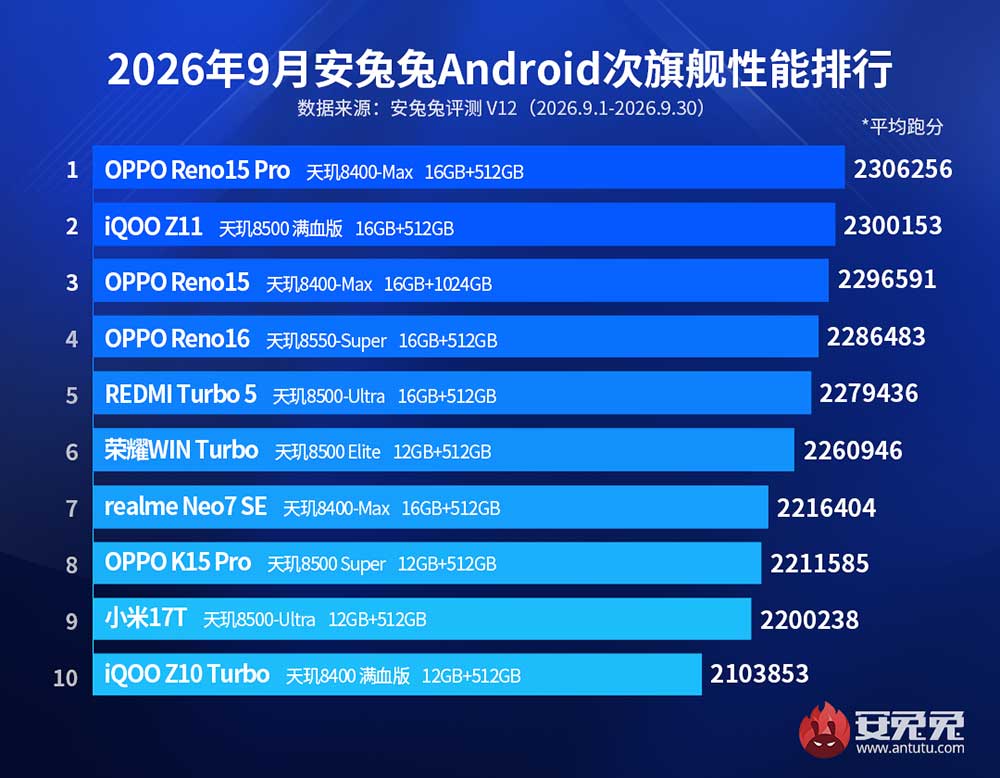
For buyers seeking near-flagship performance without paying ultra-premium prices, MediaTek-powered devices are leading the way. All 10 smartphones in the sub-flagship rankings feature MediaTek chipsets, highlighting the Taiwanese company’s strong position in this segment.
Performance is concentrated around the Dimensity 8400 and 8500 Series. OPPO takes the top spot with the Reno15 Pro, which scores 2,306,256 points using the Dimensity 8400-Max. The iQOO Z11 follows closely in second place with 2,300,153 points, powered by a Dimensity 8500 processor. The standard OPPO Reno15 ranks third with 2,296,591 points, also featuring the Dimensity 8400-Max. The OPPO Reno16, REDMI Turbo 5, and HONOR WIN Turbo claim fourth through sixth place, respectively. All three use variants of the Dimensity 8500 lineup and post scores above 2.26 million points.
Rounding out the top 10 are the realme Neo7 SE, OPPO K15 Pro, Xiaomi 17T, and iQOO Z10 Turbo. Their placements reinforce the category’s strong performance, with scores above 2.1 million points across the list.
For consumers shopping in this price-to-performance category, the rankings suggest that MediaTek has become a formidable choice. Its presence across the entire top 10 also highlights how competitive its chips have become in delivering high-end performance beyond the traditional flagship tier.
Top 10 tablets: Breaking the 5-M-point barrier
Android tablets are no longer simply trailing smartphones in benchmark performance. The latest rankings show just how far the segment has progressed, with the leading device surpassing the 5-million-point mark.
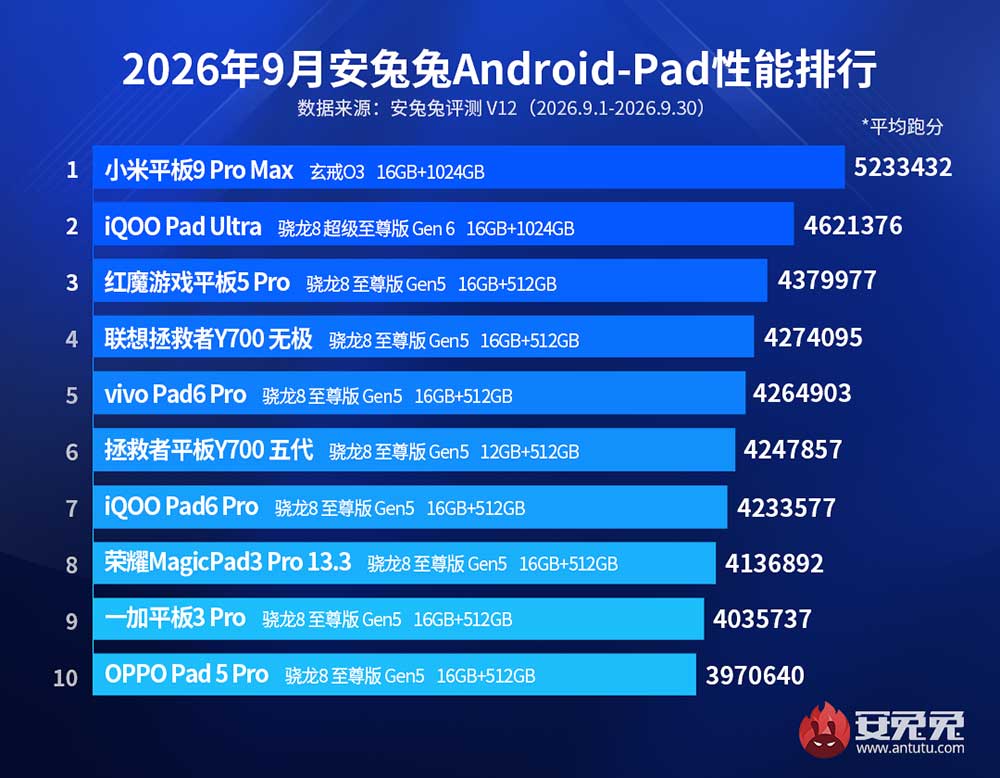
The Xiaomi Pad 9 Pro Max tops the chart with an impressive score of 5,233,432, powered by the same Xiaomi Xring O3 chipset found in the leading foldable smartphone. Its result puts considerable distance between it and the competition. The iQOO Pad Ultra takes second place with 4,621,376 points, powered by Qualcomm’s Snapdragon 8 Elite Extreme Gen 6. The RedMagic Gaming Pad 5 Pro ranks third with 4,379,977 points, followed by Lenovo’s Legion Y700 Ultimate at 4,274,095 and the vivo Pad6 Pro at 4,264,903.
The remaining positions go to the Legion Pad Y700 5th Gen, iQOO Pad6 Pro, HONOR MagicPad3 Pro 13.3, OnePlus Pad 3 Pro, and OPPO Pad 5 Pro. These devices are based on the Snapdragon 8 Elite Gen 5 and post scores ranging from 3.9 million to 4.2 million points.
The results highlight the growing performance gap between the leading tablet and the rest of the field. With the Xiaomi Pad 9 Pro Max exceeding 5.2 million points, the Android tablet segment is demonstrating that large-screen devices can compete at the highest levels of mobile computing performance.
Learn About This Author