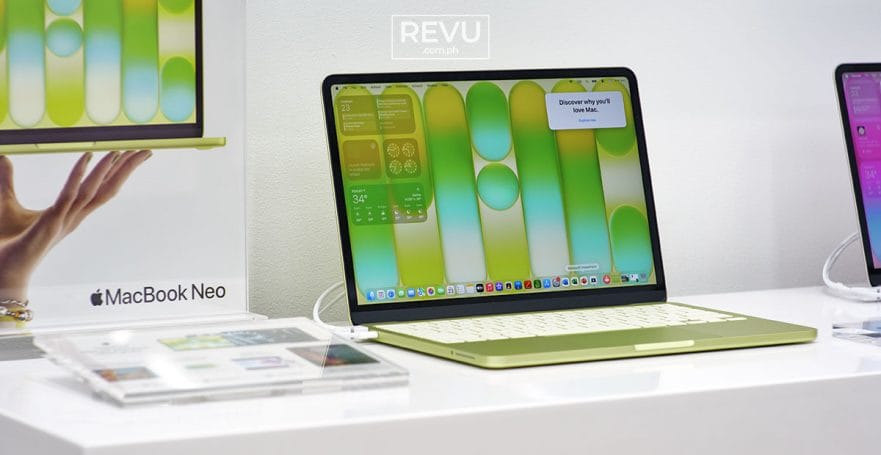
If you were saving up for a brand-new MacBook or an iPad, your financial roadmap just got derailed — aggressively.

On June 25, Apple quietly rolled out a sweeping overnight price hike, updating its official Philippine online store without warning. Unlike traditional tech price increases, which are usually hidden inside shiny generational hardware updates, this shift hits current-generation inventory overnight.

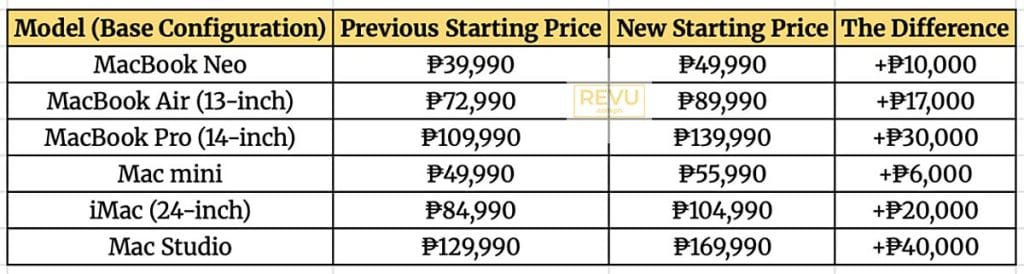
The entry-level MacBook Neo — which launched as a killer sub-₱40,000 recommendation — has suddenly jumped by ₱10,000. Premium machines like the Mac Studio are now up to ₱40,000 more expensive.
Here is exactly what happened, how much more you will pay, and why the global artificial intelligence boom is to blame.
The new Apple Philippines price list
The price adjustments vary by device, but the budget tier is taking the heaviest proportional beating. The official Apple Philippines online store has already been updated with the new suggested retail prices.

Why is Apple raising prices now? The sudden price correction stems directly from a structural crisis in the global semiconductor supply chain.
Major memory manufacturers, including Samsung, SK Hynix, and Micron, have spent the last year reallocating their manufacturing plants away from standard consumer electronics components. Instead, they are churning out high-bandwidth memory to supply Nvidia and various cloud computing giants building huge enterprise AI data centers.
This pivot has starved the consumer market of standard DRAM and NAND flash storage chips, causing global component contract prices to double over the first half of the year.
Apple has arguably the most powerful supply chain leverage in the world. If Cupertino can no longer dictate cheap component rates and is forced to pass costs down to buyers, smaller tech brands will likely face similar reckoning soon.
For the average consumer in the Philippines, this alters the value proposition of Apple’s entry-level ecosystem.
- The Apple MacBook Neo loses its best feature. When the MacBook Neo launched, its biggest selling point was its psychological ₱39,990 price tag. It allowed Apple to directly compete with midrange Windows laptops while giving students and remote workers an affordable entry point into macOS. At ₱49,990, it now goes head-to-head with highly competitive, fully featured Intel Core Ultra and AMD Ryzen notebooks, making it a much tougher sell.
- The authorized reseller safe haven. While Apple’s direct storefront updated its prices instantly, third-party authorized resellers like Beyond the Box, Power Mac Center, and Digital Walker have not raised their prices. Because these partners are still selling through inventory acquired at previous wholesale costs, their current retail SRPs remain untouched. This creates a brief but critical window for local buyers to acquire Macs and iPads at the original, lower prices before local distributor agreements inevitably adjust to the new baseline.
- The gray market premium. With official store prices climbing by as much as ₱40,000 on pro-grade hardware, the price gap between official Philippine channels and gray-market parallel importers — such as those sourcing stock from Hong Kong or the United States — will widen significantly. Expect alternative retail hubs like Greenhills to see a sharp spike in traffic from users looking to bypass the official price hikes.
Why the Apple iPhone is safe — for now
(Update, Sept. 10: Apple has quietly raised prices for the iPhone 17, iPhone 17e, iPhone 16, and iPhone Air!)
If you are planning to buy a phone, the current iPhone 17 family remains entirely unaffected by the overnight price changes. The base iPhone 17 still starts at ₱57,990, and peripherals like the Apple Watch and AirPods have also kept their original pricing.
Smartphones generally use smaller physical memory pools compared to laptops and tablets. Apple also secures its mobile components through long-term procurement contracts that shield the iPhone division from instant market fluctuations.
However, that protection has an expiration date. Supply chain analysts broadly predict that memory costs will eventually catch up to Apple’s mobile division, likely forcing a price increase on the next-generation iPhone models, the iPhone 18 Series, expected to debut globally this coming September.
Learn About This Author