Transsion Holdings is currently running away with the Philippine smartphone market, but the real question is how much you’re about to pay for your next upgrade.

A comparison of smartphone shipment market shares in Q1 and Q2 2026, based on data from market research firm Omdia, shows just how quickly the local technology landscape is shifting. Transsion — the parent company behind budget favorites Infinix, TECNO, and itel — managed to retain its No. 1 spot in the Philippines during the second quarter with a commanding 33% market share. That is a slight dip from the 37% it held in the first quarter, but it is more than enough to keep the crown.
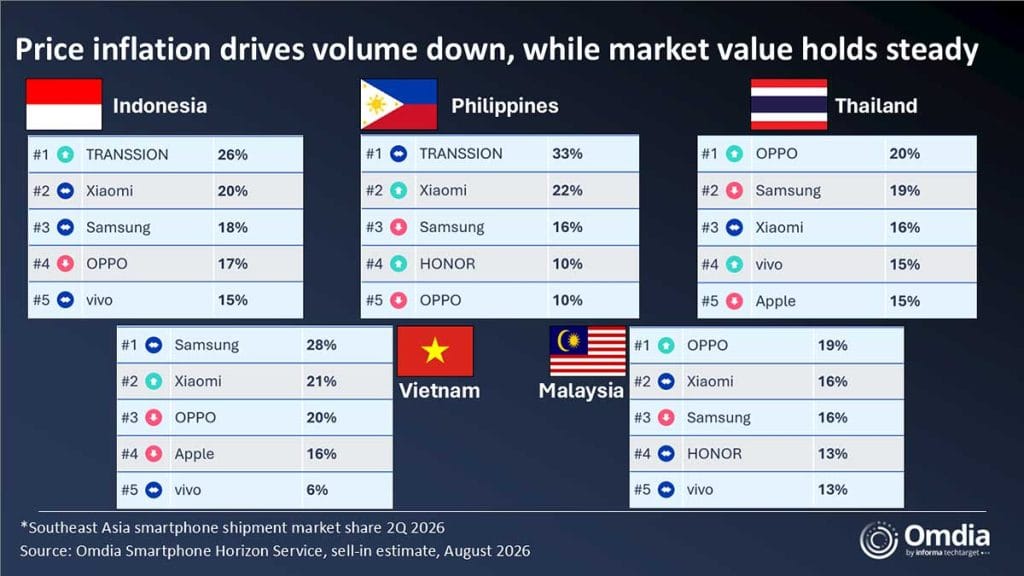
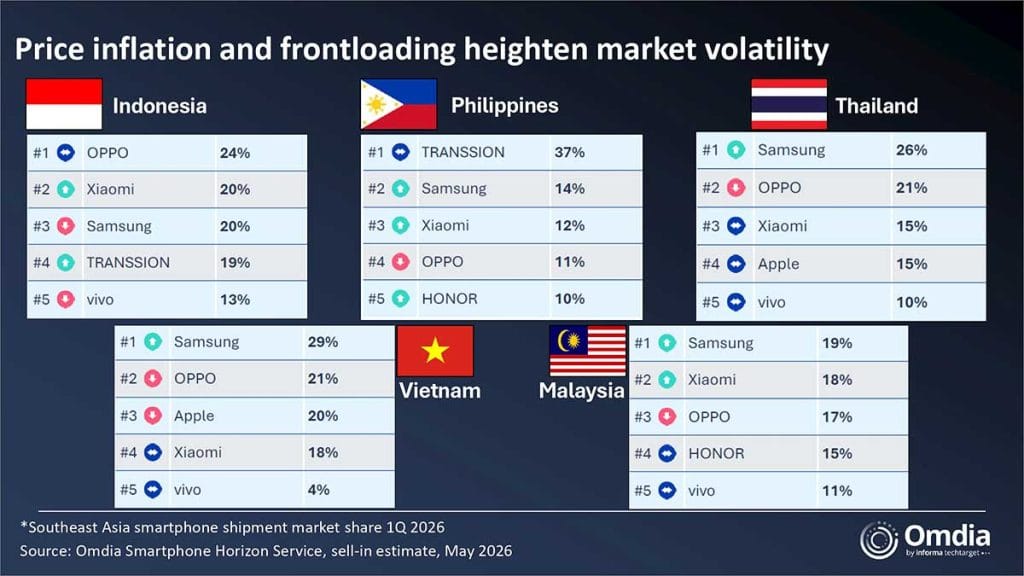
The bigger shift happened right behind it. Xiaomi surged to take second place, skyrocketing from a 12% share in the first quarter to 22% in the second. That sudden jump pushed Samsung down to third place. Even though the Korean tech giant grew its own slice of the pie from 14% to 16%, it couldn’t outpace Xiaomi’s momentum. Rounding out the top five, HONOR held steady at 10% but climbed up to fourth place, edging out OPPO, which dropped to fifth place with its own 10% share, down from 11% earlier in the year.
These ranking shifts are just the surface of a much harsher reality for the everyday Filipino buyer: The era of the ultra-cheap smartphone is quietly dying. Across the entire Southeast Asian region, smartphone shipments just plummeted by 23% year-on-year down to 19.3 million units, hitting the lowest quarterly level since 2014. Yet, strangely enough, the total market value held strong at $6.6 billion (around ₱408 billion). The math behind that is brutal for your wallet. It means companies are shipping fewer models, but they are charging significantly more for them. The average selling price of a smartphone in the region has spiked 31% to roughly $342 (₱21,200).
Brands are actively abandoning the dirt-cheap price brackets to protect their profit margins against skyrocketing global memory component costs. Transsion’s shipments of phones priced under $100 (₱6,200) plummeted 47% in the second quarter. Instead, the company is funneling its energy into the $100 to $199 (₱6,200 to ₱12,300) sweet spot, pushing newer models at notably higher launch prices.
Xiaomi is pulling a similar move, seeing its sub-$100 (sub-₱6,200) volume collapse by 69% while its overall average selling price jumped 43.5%. Even Samsung is breaking the unwritten rule of consumer tech by actually raising the prices of budget devices like the Galaxy A07 and Galaxy A17 after they launched, helping it dominate the $200 to $299 (₱12,400 to ₱18,500) tier. Meanwhile, OPPO and vivo have ghosted the lowest price tier altogether, effectively moving their most affordable models well above the hundred-dollar mark.
For a market like the Philippines that heavily relies on entry-level devices and open-market retail channels, this regional course correction hits hard. Omdia expects the Southeast Asian smartphone market to contract by 25% for the whole of 2026. The budget handsets aren’t just getting more expensive; the most affordable options are disappearing. So if you are waiting around for a huge discount to replace a battered unit, you might want to rethink that strategy, because the budget phone as we know it is fast becoming a premium commodity.
Learn About This Author