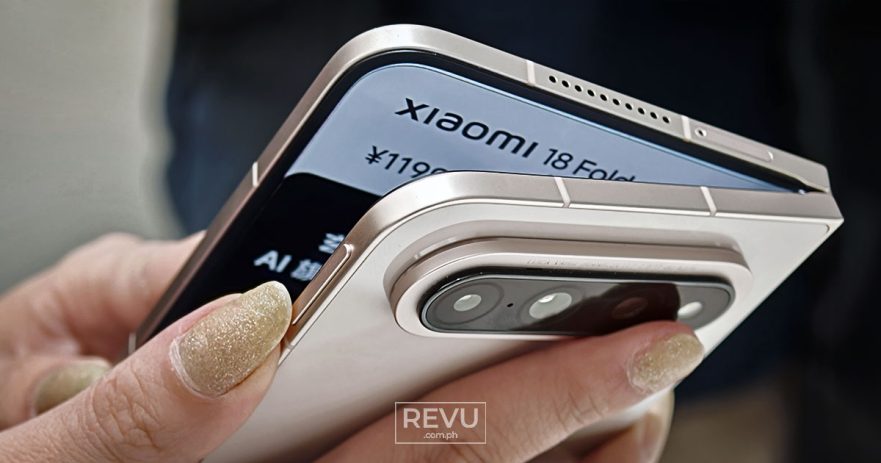
Remember when buying a flagship phone meant spending a little extra for a better camera, a gorgeous display, and a faster processor? Those days are getting further behind us. Smartphone prices are climbing, and what we now consider a premium device is becoming increasingly expensive.

According to recent market analysis from Counterpoint Research, models priced above $600 (around ₱37,700) accounted for 29% of global smartphone sales in the first half of 2026. That’s quite a jump from just 20% four years ago. Clearly, people are still willing to spend big on their handsets, but they’re also expecting a whole lot more in return.
For Filipino consumers, this means getting used to a new reality when shopping for their next unit. With devices like the upcoming Xiaomi 18 Pro Series expected to arrive in increasingly premium price brackets based on global pricing structures, understanding exactly what we are paying for requires a deeper look.
Naturally, the first things that come to mind are the usual suspects: the processor, camera sensors, screen, and materials. But when a smartphone starts creeping into laptop territory in terms of price, there’s a lot more going on behind that shiny glass and metal exterior.
We got a closer look at some of those answers during a recent visit to Xiaomi‘s operations in Beijing, China. The trip included a look inside its autonomous smartphone factory and sprawling electric vehicle manufacturing facility. But much of what drives the cost of a modern flagship happens behind the scenes, far beyond what you can see or touch.
It’s not just about titanium frames, bigger camera sensors, or the latest display technology. A good chunk of that premium goes towards years of research, highly automated factories, proprietary hardware, and an increasingly ambitious AI ecosystem designed to connect practically everything around you.
Xiaomi is playing a much bigger game now
In just 16 years, Xiaomi has gone from a smartphone startup known for offering impressive specs at surprisingly low prices to a large technology company with ambitions that stretch well beyond mobile devices.
Today, it develops its own software, designs its own silicon chips, operates highly automated manufacturing facilities, and builds electric vehicles. And somehow, Xiaomi still wants all these things to work together with the handset in your pocket. Its original promise of making amazing products at honest prices remains part of its identity. However, getting there has become a considerably more complicated — and expensive — undertaking.
Just look at the company’s research and development spending. In the first three quarters of 2025 alone, it invested ¥23.5 billion (roughly $3.3 billion or ₱207.5 billion) in R&D, increasing that figure to a whopping ¥40 billion (around $5.7 billion or ₱358.4 billion) in 2026. That’s not pocket change, even by big tech standards.
This money supports a research network spanning more than 730 laboratories across 11 cities worldwide. And Xiaomi isn’t just hiring engineers to put existing components together. As of mid-2026, 47.2% of its global workforce is dedicated to research and development. The result? More than 47,000 global patents and homegrown technologies, including its Xiaomi MiMo AI model.
Going head-to-head with premium players like HUAWEI, HONOR, and Apple requires more than simply offering a phone with impressive specifications. Xiaomi needs its own technologies, software, and intelligence to stand out. And developing those things costs money. In other words, that flagship price tag helps keep the research machine running.
Inside Xiaomi’s smartphone factory: Where 6 seconds make a difference
One of the most interesting stops during our Beijing visit was the Xiaomi Smart Factory in Changping, located on the northern edge of the city. Spanning 81,000 square meters, the facility represents an investment of ¥2.4 billion (roughly $337 million or ₱22.6 billion) and serves as one of Xiaomi’s main manufacturing hubs for flagship phones.
Calling it an ordinary factory would be a bit of an understatement. The facility has 11 production lines capable of producing more than 10 million smartphones annually. At full speed, a new unit rolls off the production line approximately every six seconds.
The robots might grab your attention, but it’s the software running the show that makes this factory particularly impressive. Xiaomi developed its own manufacturing management system, called the Xiaomi Hyper Intelligent Manufacturing Platform, or IMP. Think of it as the factory’s digital brain, keeping an eye on practically every step of production.
It monitors manufacturing efficiency in real time, handles quality control, and identifies unusual conditions before they turn into bigger problems. Running low on components? The system can automatically trigger replenishment orders without needing someone to manually step in. There’s also a rather outstanding 96.8% self-developed hardware rate, alongside 100% automation in critical processes and an overall automation rate of 81%.
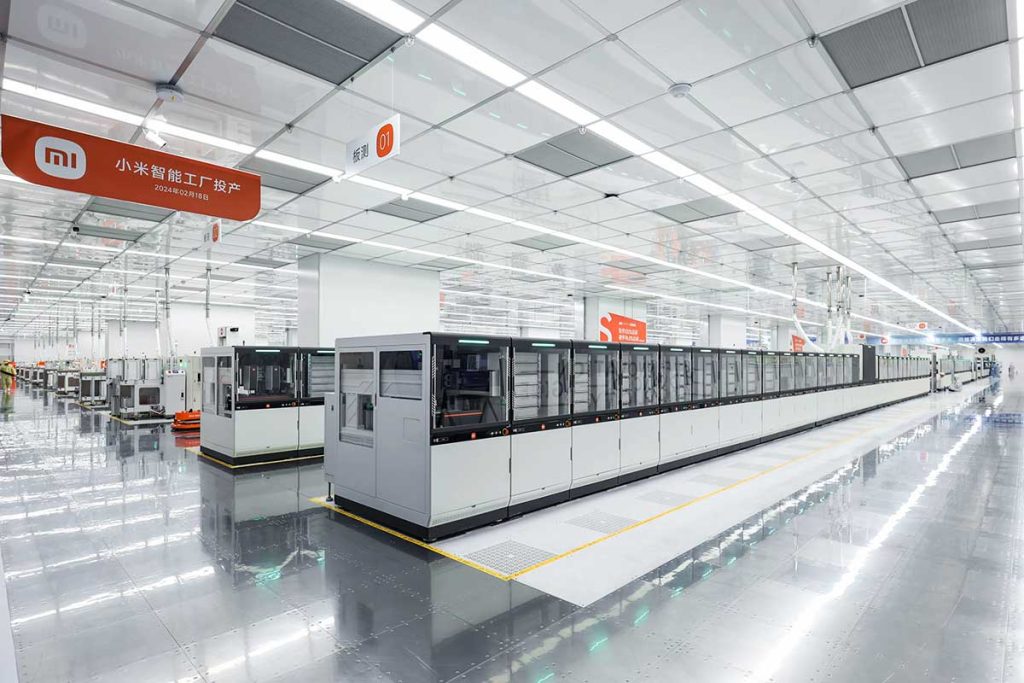
In practice, this scale of automation changes the entire assembly pipeline. The process starts with Surface-Mounted Technology equipment before moving to Main Board Assembly, where structural components such as steel plates are added. From there, the phones go through final assembly and a series of tests covering power consumption, antenna performance, and camera sensors.
AI-powered systems help evaluate these components, while large aging test chambers put as many as 2,400 devices through simulated long-term usage at the same time. These tests help check battery life and overall performance stability.
It’s a fascinating change from the factories many of us might imagine. Rather than having people manually handle every little detail, machines take care of repetitive and highly precise tasks. Human workers, meanwhile, focus on monitoring operations and making decisions that require a human touch.
The takeaway here is producing a flagship device isn’t simply a matter of assembling expensive components. There’s an enormous amount of engineering, software, and quality control involved before that unit ever reaches a retail shelf.
From smartphones to supercars: Xiaomi takes automation to another level
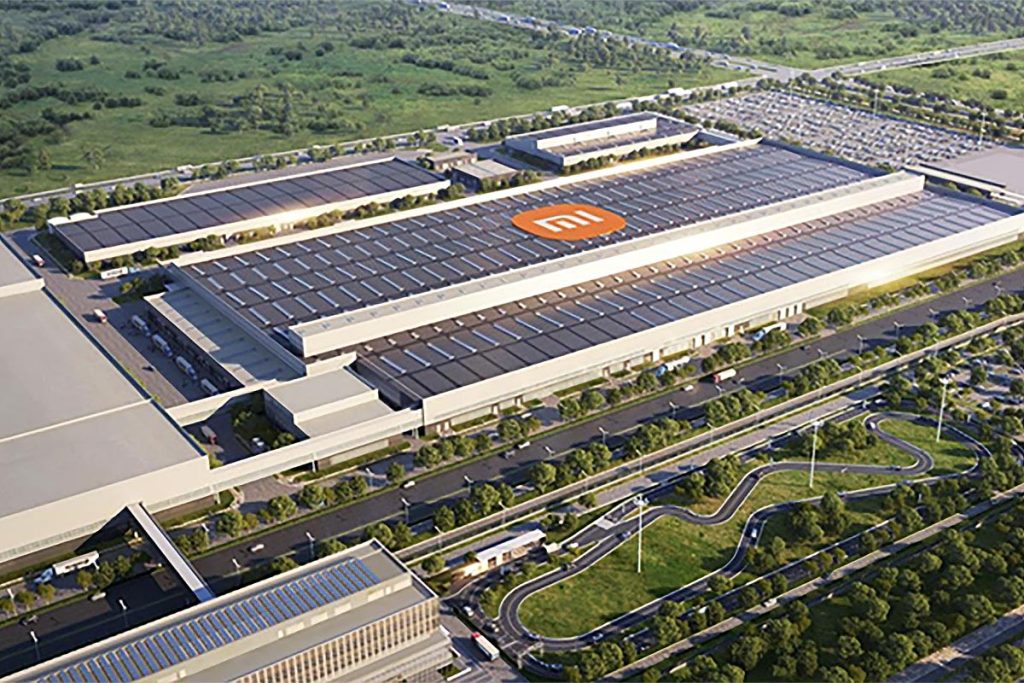
If the smartphone factory was impressive, wait until you see what Xiaomi is doing with cars. Over in Yizhuang, Beijing, the company’s EV factory makes the Changping facility look almost modest. Covering a sprawling 718,000 square meters, it’s where Xiaomi manufactures its increasingly popular electric vehicles.
During our visit, we also had the opportunity to experience the Xiaomi SU7 Ultra as passengers, alongside fellow media colleagues and celebrities Gabbi Garcia, Khalil Ramos, and Dominic Roque.
We got to experience the Xiaomi SU7 Ultra as passengers, alongside fellow media colleagues and celebrities Gabbi Garcia, Khalil Ramos, and Dominic Roque
And while going from smartphones to high-performance electric vehicles might seem like a rather ambitious career change for a tech company, Xiaomi’s manufacturing philosophy remains surprisingly familiar: develop more of the technology in-house, measure everything, and let machines handle the jobs they’re best equipped to do.
When fully ramped up, the Yizhuang facility can produce 40 vehicles per hour. That’s a new EV rolling off the assembly line approximately every 76 seconds. One of the technologies making this possible is Xiaomi’s self-developed Hyper Die-Casting T9100 cluster. It combines dozens of individual components into a single 72-in-1 integrated rear floor structure. According to the brand, this reduces production time by 45% while improving the vehicle’s structural rigidity.
The body workshop is just as impressive, boasting a 91% overall automation rate, with key processes running autonomously.
Quality control is another serious business here. The factory uses lidar scanning with an accuracy of ±0.05mm to check vehicle dimensions and ensure transparent components are properly aligned. That’s the kind of precision you’d expect from much more specialized industrial applications.
Even the painting process has some clever tricks. Xiaomi’s Quick Color Change System can switch between nine available paint colors in just 40 minutes. The paint itself goes through as many as eight layers using a 3C2B process (three coats and two bakes), which Xiaomi says improves paint film smoothness by 8% over industry standards.
And before a customer gets the keys, every Xiaomi EV must complete dynamic testing on a 2.5-kilometer track within the factory grounds. The track features 18 different road conditions designed to put the vehicle’s chassis and software through their paces.
It’s a lot of work for something that eventually gets parked in someone’s garage. But that’s precisely the point. Xiaomi’s investments in manufacturing aren’t limited to making smartphones. The same engineering mindset is now being applied to an entirely different category of products.
Your phone is no longer just your phone
Now, here’s where everything starts coming together. Xiaomi doesn’t see the smartphone as a standalone product anymore. Instead, it has built its broader strategy around something it calls “Human x Car x Home.”
The idea is relatively simple: Your smartphone should be the central hub connecting your digital life, your home, and eventually your car. The technology tying everything together is HyperOS, Xiaomi’s proprietary operating system designed to make its different devices work seamlessly with one another.
And the scale of this ecosystem is already pretty staggering. As of the second quarter of 2026, the company’s consumer AIoT platform connects more than 1.1 billion devices worldwide and serves over 175 million users. Its Xiaomi Home app alone has 124.1 million monthly active users, managing more than 2,000 Mijia smart home products across 130 categories.
That’s a whole lot of connected devices. We’re talking about everything from air conditioners and robot vacuums to tablets, appliances, and electric vehicles. And the more devices that communicate with one another, the more opportunities Xiaomi has to make its AI more useful.
Rather than simply responding to commands on a smartphone screen, the company’s vision is to develop AI that understands what users are trying to accomplish in the real world. Imagine your phone, smart home appliances, and car working together to anticipate what you need and coordinate everyday tasks. That’s the direction Xiaomi is heading towards.
Of course, this kind of functionality depends on context, connectivity, and user permission. Xiaomi’s goal is to have its devices communicate and coordinate with explicit user authorization, rather than making everything operate independently without your knowledge.
It’s an ambitious vision, but it also explains why the company is investing so heavily in software and AI. The smartphone is becoming the entry point to a much larger ecosystem, rather than just another gadget to upgrade every few years.
The local impact for Filipino buyers
Xiaomi’s growing ambitions aren’t happening in isolation from the Philippine market. It currently ranks second in Philippine smartphone shipments, with a 22% market share. As it continues expanding its premium mobile lineup and smart home portfolio, the technologies being developed and refined in China will eventually influence the products and experiences available to local consumers.
Of course, none of this makes buying a flagship an easy decision. A device like the Xiaomi 18 Pro or Xiaomi 18 Pro Max is still a considerable investment, especially for Filipino buyers who have plenty of other things competing for their hard-earned pesos.
While we don’t expect the upcoming Xiaomi 18 Pro Series to be any cheaper than its predecessors, maybe it’s time to reframe how we look at flagship pricing. You aren’t just buying a faster chip or a brighter screen anymore; you’re funding the significant R&D, automated manufacturing, and connected software ecosystem running quietly behind the scenes
But perhaps it’s time to look at flagship pricing a little differently. When you pay for a premium smartphone in 2026, you’re not just paying for a brighter display, a faster processor, or a camera with more megapixels; you’re also paying for years of research, proprietary technologies, increasingly sophisticated manufacturing processes, and the software infrastructure that connects an entire family of devices.
That doesn’t automatically mean every expensive phone is worth its asking price. Nor does it mean consumers should simply accept higher prices because a manufacturer has spent billions on R&D. At the end of the day, the product still has to deliver something genuinely useful.
But after seeing what goes on behind the scenes at Xiaomi, one thing becomes clear: There’s a lot more packed into the price of a modern flagship than what’s listed on its spec sheet.
The premium smartphone market is getting more expensive, no doubt about it. And increasingly, the real cost of a flagship isn’t just about the hardware you hold in your hand, but about the significant technological ecosystem working behind it.
Learn About This Author